
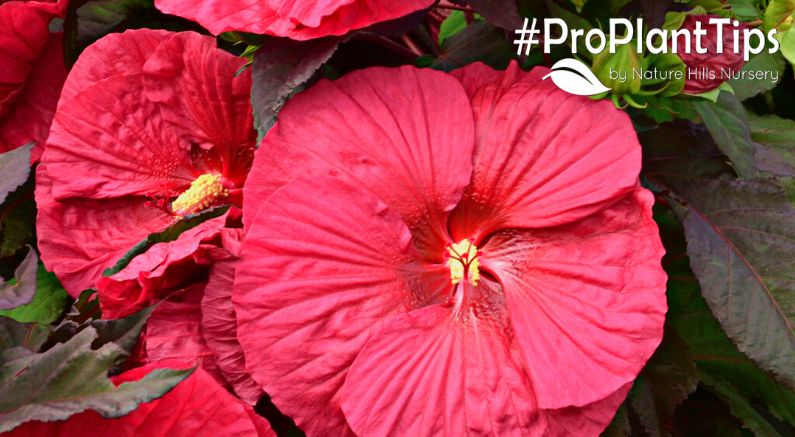
Big tropical blooms and lush greenery. Hardy Hibiscus are cold-tolerant selections of the native Rose Mallow family. They are long-lasting blooms that return every year! Major draws for pollinators and even attracting hummingbirds, the blooms stand out like vivid satellites all summer into fall!
Thriving in the full sun, deer and rabbit-resistant, heat and cold-hardy and highly adaptable, Hibiscus are gorgeous perennials that won’t take much of your time, but give back tenfold! These are low-maintenance and easy-care perennials with massive impact!
All in the Hibiscus Family
There are several types of Hibiscus, from the tropical patio style blossoms to the huge tree-form Hibiscus varieties known as Rose of Sharon. They all share similar blooms and leaves! Big trumpets or open dinner plates of brilliant petals, sometimes with darker colored ‘eyes’ and the tell-tale long spoked stamen that sticks straight out from the center of the bloom. Looking like giant silky satellites.
As lovely as backdrops in the garden bed, anchors and low screening, en masse and in rows to pump up the color and season-long display!
These Mallow family members are even edible! The blooms have been eaten or used as a garnish, eaten and dried for tea. The young shoots and leaves can be cooked and eaten, though they have the mucousy consistency similar to Okra, another Mallow family member, you may even see a similarity to their blooms and seedpods! As always, know what you are working with and if you have any allergies before trying to nibble on any of your landscaping!
Types of Hibiscus
Perennial Hardy Hibiscus

Hardy Hibiscus (Hibiscus moscheutos) is a perennial herbaceous Hibiscus. That means this plant begins to grow from the root each year in late spring. Featuring large flowers all summer and into fall with huge rounded single flowers and many have purplish and red foliage too.
They are usually hardy from zones 4 or 5 through zone 9. In the late fall when exposed to frost the plant is done for the year. The stems, although can seem kind of woody, the plant is still a perennial and will need to be cut to the ground each year and all new shoots arise from the roots each spring.
Tropical Hibiscus

Tropical Hibiscus (Hibiscus rosa-sinensis) is sometimes called Hawaiian Hibiscus or even Chinese Hibiscus. This one is usually used on patios and porches as summer-blooming tropical plants. Some people will then bring them inside before the danger of frost (as they cannot be exposed to freezing temperatures or they will die) and grow them as a houseplant in a sunny window for the winter until they can be moved outside after the danger of frost.
These flowers can be singles or doubles and come in many colors. This is also a tropical plant used outdoors in tropical climates where it will not freeze.
Rose of Sharon Hibiscus Shrubs

Rose of Sharon Hibiscus (Hibiscus syriacus) Shrub-Form is a woody shrub generally hardy zone 5 through 9. It is a deciduous shrub that in the fall, the leaves turn yellow and brown and drop off the plant. They are fairly large shrubs, especially in the warmer zones and not overly aggressive in the coldest zone because they can die back. The flowers can be single or very double almost like a carnation flower.
This shrub form plant blooms late summer into fall and the bloom is profuse. The newer cultivars are sterile or non-invasive, and some of the older ones can re-seed producing new seedlings near the plant. Flowers come in pinks, white, blue and purple. Flowers are produced on new growth so they can be pruned in early spring to reduce size or renewal prune.
Rose of Sharon Hibiscus Tree-Form
Rose of Sharon Hibiscus (Hibiscus syriacus) Tree-Form is the same woody deciduous plant as above but trained as a single stem (trunk) coming from the ground as a tree-form plant that stays a smaller ornamental tree with many flowers late summer into fall. Hardy in zones 5-9.
Nature Hills Nursery Top 5 Hardy Hibiscus Shrubs
#5 Hollywood™ Tropical Hibiscus Chatty Cathy™
Brilliant sunshine lemon yellow petals and anther of these trumpet-shaped blossoms are highlighted by an incredibly hot pink to scarlet red eye and cute red fuzzy stigma.
#4 Hardy Perennial Hibiscus Cherry Choco Latte

Gorgeous bright pink blooms and a deep magenta eye that radiates out into the veins and heavily streaks each petal. Backed by dramatically dark blackish-green foliage, each of the nearly foot-wide blooms completely covers this entire shrub!
#3 Luna Perennial Hibiscus
Red, Pink, White and rosy-Magenta, The huge blooms of the Luna are enormous whorled satellites of highly saturated color! With brilliant red centers and long yellow stamen sticking out from the center. The small, compact plants become covered in long-lasting blooms all summer.
#2 Head Over Heels® Perennial Hibiscus

The incredibly dark foliage that’s near black, dark-purplish and deep red becomes a dramatic backdrop to the large wide-open trumpet-shaped blooms. Two varieties are available, Blush is a lovely pink with a dark red eye and Passion is brilliant hot pink, both stand out against the dark foliage.
#1 Cranberry Crush Perennial Hibiscus
The number one spot goes to the glorious red blooms of Cranberry Crush Hibiscus! With petals so large they overlap, these enormous, vividly hued blossoms grow on a compact green-leafed shrub. These are highly disease-resistant, salt, sun and soil type tolerant perennial shrubs!
Very hardy plants, both deer and rabbits tend to leave them alone but they draw pollinators and hummingbirds in droves! There’s not much more you can ask for in a low-maintenance landscape plant!
Nature Hills Top 5 Tree-Form Hibiscus Picks
#5 Smoothie® Hardy Rose of Sharon

The Smoothie® Line of Rose of Sharon tree-form is a Hibsicus family member with incredible double blooms full of ruffled petals in saturated color through and through. Available in double Blueberry and Raspberry hues, these solid-colored flowers are backed by handsome green foliage.
#4 Satin Rose of Sharon Tree-Form
Available in deeply saturated Rose, Azurri lavender-Blue, rosy-Violet, pale Orchid, and deep Purple blooms with silky petals all have a brilliant red eye! Backed by lush foliage these are very hardy and adaptable shrubs.
#3 Ruffled Satin® Rose of Sharon Tree-Form

Brilliant rosy pink with a bright red eye, these ruffled whorled blossoms bloom from Summer through autumn, tolerate humidity, soil types, salt, and are more columnar for tight spaces!
#2 Blushing Bride Rose of Sharon Tree-Form
Upright growing, compact and great for tight spaces, the columnar Blushing Bride is a double pale pink blossom with rosy red centers that attract pollinators and hummingbirds galore!
#1 Chiffon® Rose of Sharon Trees
Lavender, White, Pink, and Blue Chiffon, this line of nearly double blooms are pure color through and through. The big fluffy petals, stamen and lacking a colorful eye, Chiffon® Hardy Hibiscus are one solid saturated hue inside and out!
The Choice is Yours!

With so many choices available for you at Nature Hills, you’ll certainly be able to find the Hardy Perennial Hibiscus perfect for you and your landscape! From the tallest Purple Pillar® Rose of Sharon or Red Heart Rose of Sharon Shrub, to the smallest Lil' Kim® Rose of Sharon and Hibiscus Luna White. Plus a wide range of incredibly cold-hardy varieties and heat tolerant types.
Check out all these incredible tropical blooms for your landscape today, regardless of how cold your winters are, you’ll enjoy exotic blooms and long-lasting color with ease!
Happy Planting!

