
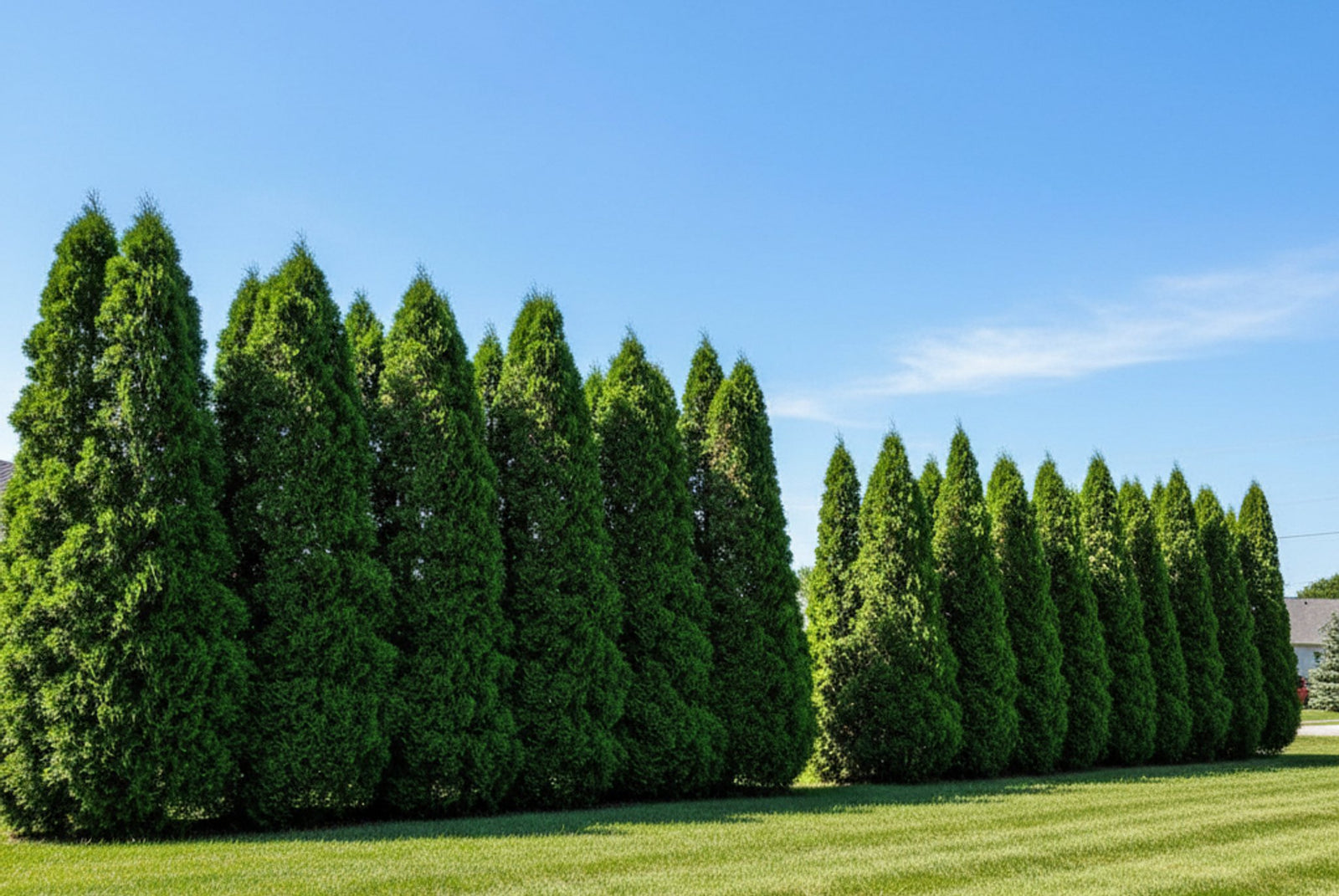
Emerald Green and Green Giant are the two most popular arborvitae in the country, and they could not be more different. One is a compact, slow-growing column for tight spaces. The other is a fast-growing giant that creates a towering living wall. Picking the wrong one means either a tree that overwhelms your yard or one that takes a decade to give you any privacy.
Green Giant is the bulldozer. Emerald Green is the scalpel. One fills a football field with green in five years. The other tucks neatly along a fence line without swallowing the patio. The right choice depends on your space, your climate, and how patient you are.
Here is the honest, side-by-side breakdown so you can pick the right one on the first try.
Quick Comparison: Emerald Green vs Green Giant
| Feature | Emerald Green | Green Giant |
|---|---|---|
| Botanical Name | Thuja occidentalis 'Smaragd' | Thuja standishii x plicata 'Green Giant' |
| USDA Zones | 3-8 | 5-8 |
| Mature Height | 12-15 ft. | 40-60 ft. |
| Mature Width | 3-4 ft. | 12-18 ft. |
| Growth Rate | 1-2 ft./year | 3-5 ft./year |
| Deer Resistance | Low (frequently browsed) | High (rarely browsed) |
| Cold Hardiness | Excellent (Zone 3) | Good (Zone 5) |
| Disease Resistance | Moderate (watch for bagworms, leaf blight) | High (hybrid vigor, few issues) |
| Hedge Spacing | 3-4 ft. apart | 5-6 ft. apart |
| Best For | Small yards, narrow spaces, formal hedges | Large lots, fast privacy, windbreaks |
Best Arborvitae for Fast Privacy: Green Giant
Zones 5-8 | Mature Size: 40-60 ft. tall, 12-18 ft. wide | Growth Rate: 3-5 ft./year
Green Giant Arborvitae is the fastest-growing privacy tree you can buy. At 3 to 5 feet of new growth per year, a 5-foot starter tree reaches 15 feet in just three growing seasons. That is fast enough to screen out a two-story neighbor in a few years, not a decade.
Green Giant is a hybrid cross between Japanese Arborvitae (Thuja standishii) and Western Red Cedar (Thuja plicata), and it inherited the best traits of both parents. The foliage stays rich, dark green through winter without the bronzing that plagues many arborvitae. It shrugs off heat, humidity, and most diseases. Bagworms can be an issue in some areas, but Green Giant is far more resistant than Emerald Green.
The biggest advantage beyond speed? Deer resistance. Green Giant has an aromatic quality that deer consistently avoid. If you live in deer country and want arborvitae, this is the safer bet by a wide margin.
The tradeoff is size. Green Giant grows into a very large tree. Without pruning, it will reach 40 to 60 feet tall and spread 12 to 18 feet wide. That is too big for a small suburban lot, and it can overwhelm a side yard or driveway planting. You need room for this one.
Best Arborvitae for Small Yards: Emerald Green
Zones 3-8 | Mature Size: 12-15 ft. tall, 3-4 ft. wide | Growth Rate: 1-2 ft./year
Emerald Green Arborvitae (sometimes sold as 'Smaragd', the Danish word for emerald) is the go-to arborvitae for tight spaces. Its naturally narrow, columnar shape tops out at 12 to 15 feet tall and just 3 to 4 feet wide. That slim profile fits along property lines, next to driveways, in side yards, and anywhere you need screening without sacrificing lawn space.
Emerald Green holds its rich green color better than most arborvitae through cold winters, which is one reason it is the top-selling arborvitae in northern states. It handles Zone 3 winters without complaint, giving it a two-zone advantage over Green Giant in cold hardiness.
The downsides are real, though. Growth rate is modest at 1 to 2 feet per year, so building a solid screen takes patience. Deer browse Emerald Green aggressively in many areas; in heavy deer pressure zones, you may need fencing or repellent for the first few years. And while the narrow form is an advantage in tight spaces, it means you need more plants spaced closer together to fill in a hedge line.
Size and Growth Rate Compared
This is where the decision often makes itself. Green Giant reaches 20 feet in about 4 to 5 years from a typical 5-foot nursery container. Emerald Green takes roughly 8 to 10 years to hit the same height, and it will never get much taller than 15 feet.
If you are screening a two-story house or creating a windbreak on a rural property, Emerald Green simply is not tall enough. If you are lining a driveway or creating a 6-foot hedge along your patio, Green Giant is overkill and will require constant pruning to keep in bounds.
Best Arborvitae for Cold Climates
Emerald Green is reliably hardy to Zone 3, handling winter temperatures down to -40F. Green Giant bottoms out at Zone 5, where winter lows hit -20F.
If you garden in Zones 3 or 4 (Minnesota, Wisconsin, northern New England, Montana), Emerald Green is your only option between these two. Green Giant will suffer winter damage or die outright.
In Zones 5 through 8, both are fully hardy and the choice comes down to size, speed, and deer pressure.
Best Arborvitae for Deer Resistance
This is often the deciding factor for suburban and rural gardeners. Deer browse Emerald Green heavily. They treat it like a salad bar, especially in winter when other food is scarce. A newly planted Emerald Green hedge can be stripped bare overnight.
Green Giant is rarely touched. The hybrid parentage gives it a stronger aromatic profile that deer consistently avoid. No arborvitae is truly deer-proof, but Green Giant comes as close as it gets.
If you have moderate to heavy deer pressure and your zone supports both varieties, Green Giant is the safer investment.
Best Arborvitae for Windbreaks
Green Giant's size and density make it the superior windbreak tree. A mature row of Green Giants can cut wind speed by 50% or more for a distance of 10 times the tree height downwind. On rural properties, farm edges, and exposed lots, that wind reduction protects gardens, reduces heating costs, and keeps snow from drifting across driveways.
Emerald Green works as a light wind filter at the residential scale but lacks the mass to handle sustained prairie winds or heavy nor'easters. For serious wind protection, go with Green Giant.
Disease and Pest Resistance
Green Giant holds a clear advantage here. Its hybrid vigor gives it strong natural resistance to bagworms, spider mites, and the fungal blights that plague many Thuja occidentalis cultivars. It is not immune, but problems are uncommon with proper spacing and air circulation.
Emerald Green is more susceptible to bagworms and can develop issues with leaf blight in humid climates or when planted too tightly. Good spacing (3 to 4 feet center to center) and morning sun exposure help keep Emerald Green healthy. Inspect annually for bagworm cases in late spring and remove them by hand if you spot any.
Spacing and Planting Guide
Proper spacing determines whether your hedge fills in uniformly or turns into a crowded mess with bare lower branches.
Green Giant Spacing
- Privacy screen: 5-6 ft. apart, center to center
- Specimen or windbreak: 10-12 ft. apart
- Distance from structures: At least 8-10 ft. from foundations, fences, and power lines
Emerald Green Spacing
- Tight hedge: 3 ft. apart, center to center
- Looser screen: 4 ft. apart
- Distance from structures: At least 2-3 ft. from fences and foundations
Cost Comparison
Emerald Green requires tighter spacing because of its narrow width. A 50-foot hedge line needs roughly 13-17 Emerald Green trees versus 9-10 Green Giants. Emerald Green trees are generally less expensive per plant, but you need more of them. Green Giant costs more per tree but you buy fewer. For most hedge projects, the total investment ends up surprisingly similar.
Both varieties arrive as container-grown plants, ready to go in the ground any time the soil is workable. Dig the hole twice as wide as the root ball and exactly as deep. Set the top of the root ball level with the surrounding soil. Backfill with native soil, water deeply, and mulch 2 to 3 inches out to the drip line. Keep mulch 4 to 6 inches away from the trunk.
Maintenance and Long-Term Care
Neither arborvitae demands heavy maintenance, but there are differences worth knowing.
Pruning: Green Giant rarely needs pruning. Its natural form is dense and symmetrical. If you want to control height (and on a small lot, you eventually will), plan on annual topping once it reaches your target height. Emerald Green holds its columnar shape with minimal trimming. A light shearing in late spring keeps the hedge crisp, but it is optional.
Watering: Both need consistent moisture during the first two growing seasons. After that, they are moderately drought-tolerant. Deep watering during extended dry spells keeps the foliage dense and green. Shallow, frequent watering encourages surface roots and makes trees less stable.
Fertilizing: A slow-release granular fertilizer in early spring supports healthy growth. Do not over-fertilize. Excess nitrogen pushes soft growth that is more susceptible to winter damage.
Which Should You Choose?
The decision comes down to three things: your space, your zone, and your deer pressure.
Choose Emerald Green Arborvitae if:
- You garden in Zones 3 or 4
- You have a narrow planting strip (under 6 feet wide)
- You want a formal, columnar hedge under 15 feet
- Deer pressure is low in your area
- You prefer a slower-growing, lower-maintenance plant
Choose Green Giant Arborvitae if:
- You need privacy fast (within 3-5 years)
- You have room for a tree that reaches 40+ feet
- Deer are a problem in your area
- You need a windbreak or sound barrier
- You garden in Zones 5-8
Still not sure? Many gardeners use both. Green Giant anchors the back corners of a property for fast, tall screening. Emerald Green lines the side yard or front foundation where a slimmer profile fits better. They complement each other well in any landscape.
Explore Your Options
Browse Green Giant Arborvitae and Emerald Green Arborvitae at Nature Hills, or explore the full Arborvitae collection for other varieties like North Pole, Spring Grove, and Techny. Need more screening options? Check out our Privacy Trees collection. Every tree ships container-grown with an established root system, ready to start growing in your landscape.


