
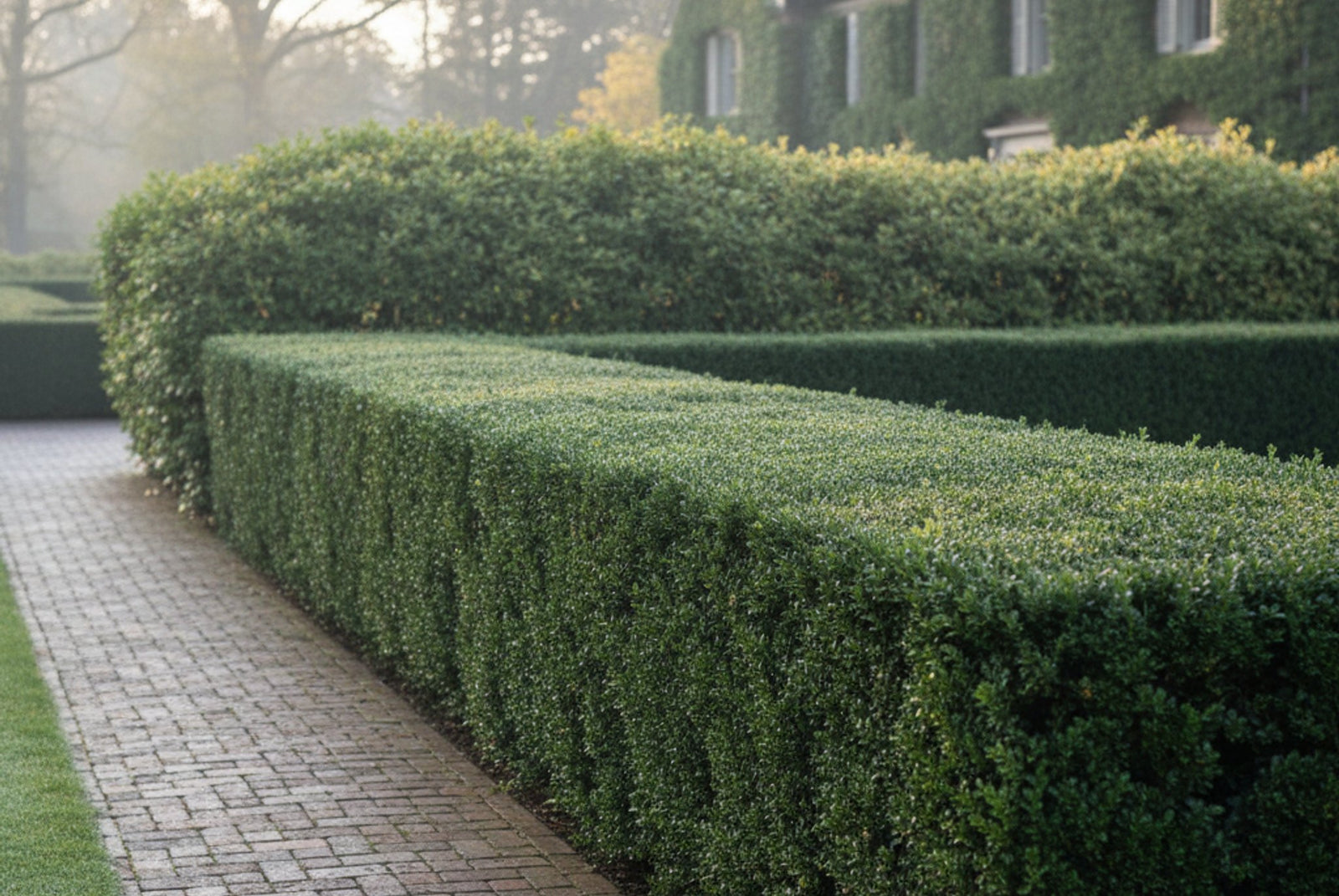
Walk through any established neighborhood and you will see two hedge plants more than any others: boxwood and privet. Both have earned their reputation over centuries of garden use, but they solve very different problems. Choosing the wrong one means years of fighting against the plant's natural habits instead of working with them.
This guide breaks down every factor that matters so you can pick the hedge that actually fits your yard, your schedule, and your budget.
Boxwood at a Glance
Boxwood (Buxus spp.) is the backbone of formal garden design around the world. Its dense, fine-textured evergreen foliage holds a sheared shape better than almost any other plant, which is why you see it framing doorways, lining walkways, and anchoring foundation beds from Virginia estates to English cottage gardens.
The genus offers a wide range of sizes. Compact cultivars stay under 4 feet, while American Boxwood can reach 15 to 20 feet at maturity. That flexibility means there is a boxwood for nearly every hedge application, from ankle-high garden edging to a substantial property screen.
Browse the full selection at our Boxwood Bushes collection.
Privet at a Glance
Privet (Ligustrum spp.) is the workhorse of fast, affordable hedging. Where boxwood measures growth in inches, privet measures it in feet. A new privet hedge can reach functional screening height in just two to three growing seasons, which is why it has been the go-to choice for homeowners who need coverage now.
Most privet species are semi-evergreen in colder zones and fully evergreen in the South. They tolerate a wide range of soil and light conditions and respond well to repeated hard pruning. If you need a tall, dense hedge on a budget, privet delivers.
Explore our Privet Bushes collection to see what is available for your zone.
Head-to-Head Comparison
| Factor | Boxwood (Buxus) | Privet (Ligustrum) |
|---|---|---|
| Hardiness | Zones 5-9 (varies by cultivar) | Zones 5-9 (varies by species) |
| Mature Height | 2-20 ft. (cultivar dependent) | 8-15 ft. |
| Growth Rate | Slow to moderate: 3-6 in./year | Fast: 2-3 ft./year |
| Winter Foliage | Evergreen year-round | Semi-evergreen to evergreen (zone dependent) |
| Deer Resistance | High | Low to moderate |
| Pruning Frequency | 1-2 times per year | 3-4 times per year |
| Sun Requirements | Full sun to partial shade | Full sun to partial shade |
| Soil Tolerance | Well-drained, slightly acidic to neutral | Wide range, very adaptable |
| Cost per Plant | Higher | Lower |
| Formal Hedge Quality | Excellent: holds tight geometric shapes | Good: softer texture, needs more frequent shearing |
Growth Rate: The Biggest Difference
This is where the two plants diverge most dramatically. Boxwood adds 3 to 6 inches of new growth per year, depending on cultivar and conditions. That slow, controlled habit is actually an advantage for formal hedges because it holds its shape longer between trimmings and stays proportional for years.
Privet, on the other hand, pushes 2 to 3 feet of new growth annually. That is roughly six to ten times faster than boxwood. If you need a functional privacy screen within a couple of seasons, privet gets you there. The tradeoff is more frequent pruning to keep it from getting leggy or outgrowing its space.
Best Boxwood Varieties for Hedges
Green Velvet Boxwood
Zones 5-8 | Mature Size: 3-4 ft. tall and wide | Growth Rate: 3-4 in./year
A cold-hardy hybrid that keeps its dark green color through harsh winters better than most boxwoods. Green Velvet is ideal for low to medium formal hedges and garden borders. Its naturally rounded form needs minimal shaping.
Green Mountain Boxwood
Zones 5-9 | Mature Size: 5 ft. tall, 3 ft. wide | Growth Rate: 4-6 in./year
An upright, pyramidal form that works beautifully as a taller formal hedge or specimen accent. Green Mountain has excellent winter color retention and handles cold better than many boxwood cultivars. A strong choice for structured borders in colder regions.
Wintergreen Boxwood
Zones 5-8 | Mature Size: 3-4 ft. tall, 3-4 ft. wide | Growth Rate: 3-4 in./year
True to its name, Wintergreen holds rich green foliage through winter without the bronzing that plagues many boxwoods. Compact and dense, it is one of the best choices for a neat, low hedge in zones with cold winters.
American Boxwood
Zones 5-9 | Mature Size: 15-20 ft. tall, 8-10 ft. wide | Growth Rate: 4-6 in./year
The grand dame of the boxwood world. Buxus sempervirens is the species you see in historic Southern gardens and formal estate landscapes. Left unpruned, it becomes a large, billowing shrub or small tree. Sheared regularly, it forms a substantial tall hedge with unmatched density. For gardeners who want a boxwood hedge over 5 feet, American Boxwood is the one to plant.
Best Privet Varieties for Hedges
Several privet species perform well as hedging plants. Japanese Privet (Ligustrum japonicum) stays evergreen through Zone 7 and reaches 8 to 12 feet, making it one of the best choices for Southern screening hedges. Zones 7-10 | Mature Size: 8-12 ft. tall, 6-8 ft. wide | Growth Rate: 2-3 ft./year
California Privet (Ligustrum ovalifolium) is the classic hedging privet for cooler zones, semi-evergreen in Zones 5-8. It shears beautifully and fills in fast. Zones 5-8 | Mature Size: 10-15 ft. tall, 6-8 ft. wide | Growth Rate: 2-3 ft./year
Wax Privet (Ligustrum japonicum 'Texanum') delivers glossy, thick foliage on a more compact frame, topping out around 6 to 8 feet. It is a strong option for a shorter, dense screen in warmer climates. Zones 7-11 | Mature Size: 6-8 ft. tall, 4-6 ft. wide | Growth Rate: 1-2 ft./year
Best Hedge for Formal, Geometric Shapes
Boxwood wins this category outright. Its slow growth and fine leaf texture let you carve precise, crisp edges that hold their shape for months between trimmings. There is a reason every knot garden and parterre in the world uses boxwood. If you want your hedge to look architecturally sharp with minimal effort, plant boxwood.
Privet can be sheared into formal shapes, but its larger leaves and aggressive growth mean the lines soften quickly. You will need to trim three to four times during the growing season to maintain tight geometry, compared to once or twice for boxwood.
Best Hedge for Fast Privacy Screening
Privet wins here, and it is not close. A row of privet planted 3 to 4 feet apart on center will form a solid visual barrier in two to three years. An equivalent boxwood hedge might take eight to ten years to reach the same height, depending on cultivar.
If you need screening height (8 feet or more) and you need it fast, privet is your plant. Pair it with a soaker hose and consistent feeding during the first two growing seasons and the results will impress you.
Best Hedge for Low Maintenance
Boxwood requires less ongoing work once it reaches your target size. One to two light shearings per year keeps a boxwood hedge looking sharp. Privet demands three to four trimmings per season, and if you skip one, you will have wild shoots sticking up everywhere.
That said, boxwood does need attention to soil drainage and air circulation to stay healthy. Wet feet and stagnant air invite root rot and the fungal diseases that plague boxwood (more on that below). Privet is far more forgiving about soil conditions and shrugs off most problems.
Best Hedge for Winter Interest
Boxwood is fully evergreen in all its recommended zones. The foliage stays dense and green through winter, giving your landscape structure and color when everything else has gone dormant. Some cultivars bronze slightly in deep cold, but varieties like Wintergreen and Green Velvet resist that bronzing better than most.
Privet is evergreen in Zones 7 and warmer. In Zones 5-6, most privets are semi-evergreen to deciduous, dropping a portion or all of their leaves in winter. If you live in a colder zone and want year-round screening, boxwood is the more reliable choice.
Cost per Linear Foot: What to Budget
Boxwood costs more per plant and requires more plants per linear foot because of its slower spread. For a standard 3 to 4 foot formal boxwood hedge planted 24 to 30 inches apart, expect to budget roughly $40 to $80 per linear foot depending on the cultivar and starting size.
Privet is significantly more affordable. Plants cost less individually, and because privet fills in so fast, you can space them 3 to 4 feet apart and still get a solid hedge within a couple years. Budget roughly $10 to $25 per linear foot for a privet hedge.
Over a 50-foot property line, that difference adds up. Boxwood might run $2,000 to $4,000 for the plants alone, while privet comes in at $500 to $1,250. However, remember that boxwood's slower growth means less labor over time, and boxwood hedges typically add more to property value.
The Boxwood Blight Question
No honest boxwood discussion skips boxwood blight (Calonectria pseudonaviculata). This fungal disease has devastated boxwood plantings across the Eastern United States since its arrival around 2011. It causes rapid leaf drop, dark stem lesions, and can kill a mature hedge in a single season under the right conditions.
Here is what you need to know:
- Not every region is equally affected. Blight thrives in warm, humid conditions with poor air circulation. Gardens in the Deep South and Mid-Atlantic face the highest risk.
- Cultivar selection matters. Some boxwoods show much better resistance than others. Look for cultivars bred for blight tolerance when shopping.
- Cultural practices reduce risk. Good air circulation (don't crowd plants against walls or fences), drip irrigation instead of overhead watering, and prompt cleanup of fallen leaves all help.
- Container-grown plants from reputable nurseries are safer. Blight often spreads through infected nursery stock. Buying from a trusted source like Nature Hills reduces that risk.
Privet is not affected by boxwood blight, which is one reason some gardeners in high-risk areas choose privet as an alternative hedge plant.
Deer: A Deciding Factor in Many Yards
If deer browse is a constant battle in your landscape, boxwood has a clear edge. Deer generally avoid boxwood due to its bitter, alkaloid-rich foliage. It is one of the most reliably deer-resistant broadleaf evergreens available.
Privet is not deer candy, but it is not off the menu either. Hungry deer will browse privet, especially new growth in spring. In areas with heavy deer pressure, a privet hedge may need supplemental protection or you may want to lean toward boxwood instead.
Which Should You Choose?
The right answer depends on what matters most to you:
Choose boxwood if:
- You want a formal, geometric hedge with clean lines
- You prefer less frequent pruning (1-2 times per year)
- Year-round evergreen foliage is non-negotiable
- Deer pressure is a concern
- You are willing to invest more upfront for a hedge that adds lasting property value
- Your target hedge height is under 5 feet (compact cultivars) or you are patient enough for American Boxwood to reach 10+ feet
Choose privet if:
- You need a tall privacy screen and you need it fast
- Budget is a primary concern
- You are in Zone 7 or warmer where privet stays evergreen
- You don't mind trimming several times per growing season
- You want a hedge over 8 feet tall without waiting a decade
- Boxwood blight is a serious concern in your area
Some gardeners use both. A formal boxwood hedge along the front walkway, and a tall privet screen along the back property line. There is no rule that says you have to pick just one.
#ProPlantTip: Set Your Hedge Up for Success
Whether you go with boxwood or privet, dig a trench instead of individual holes when planting a hedge row. A trench ensures consistent depth and spacing, and it lets you amend the entire planting zone evenly. Set your container-grown plants so the top of the root ball sits level with the surrounding soil, backfill, water deeply, and mulch 3 inches deep. Keep mulch pulled back from the stems.
Featured Picks
Shop these top picks at Nature Hills: Green Velvet Boxwood, Wintergreen Boxwood, Japanese Privet. Every plant ships container-grown with an established root system.
Start Your Hedge This Season
Both boxwood and privet ship container-grown from Nature Hills with established root systems ready to perform in your landscape. Browse our Boxwood Bushes and Privet Bushes collections to find the right fit for your zone, your yard, and your vision.

