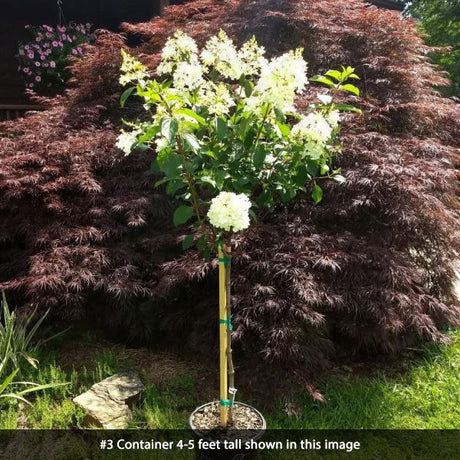
Hydrangea bushes are stunning all on their own! But when our expert growers train them into a single-stem tree form with a nice, uniform head that covers itself with flowers... the results are breathtaking!
Hydrangea Trees take all the drama and elegance of the shrub form - many of which are already your favorite varieties - and elevate them into a high-end display!
Check out Nature Hills' favorite Hydrangea Trees and our #ProPlantTips to care for them!
Nature Hills Top Tree Form Hydrangeas!
Unlike Mophead Hydrangeas with round puffball-type flowers, or Lacecap Hydrangeas with their flattened flower clusters, Panicle Hydrangeas form upright, almost columnar to conical-shaped flowering spires that have pointed ends.
Typically, Panicle Hydrangeas are used to create these deciduous shrubs grown on a 2-3 or 3-4 foot standard (trunk). The cultivar used to produce these plants will dictate the mature size of the head that grows on top of the standard. The shrub can reach its mature size atop this trunk to create a flowering lollipop-type tree that stands head and shoulders above other flowering shrubs!
Panicle Hydrangeas are chosen for tree forms because they are hardy, easy to grow, and only need some sun, well-drained soil, and a once-a-year pruning job to keep them nice. There’s no need to worry about soil pH or flower color changes depending on acid or alkaline soil with Panicle Hydrangeas! They’re fantastic for pollinators and look great as cut flower focal points in bouquets.
Tree Form Flowering Hydrangeas are fantastic for large planters, as front yard curb appeal specimens, and sunny garden focal points. Any location where you need a living sculpture or a flowering exclamation point will benefit from one of these amazing plants!
For a cohesive look, mix these tree-form Hydrangeas with their matching shrub forms for a tiered landscape effect, or blend them with Roses and other flowering shrubs as accents. A Hydrangea tree on its own on a berm stands out beautifully with a lacy skirting of flowering perennials or flowering groundcover around its base.
Check out these great options and find which is best for your landscaping needs!
The Fan Favorite - First Editions® Vanilla Strawberry™ Hydrangea Tree

Delivering a huge floral display that lasts for months, the Vanilla Strawberry™ Hydrangea tree form becomes a living work of art for your garden! Big white blooms start turning pink after cooler evening weather sets in. Starting in the center, the color spreads across the bloom, finally developing a memorable shade of strawberry red. The limbs take on a more cascading look as they become weighted with blooms.
- Large creamy white flowers gradually transform strawberry red
- Cascading branches & tall yet narrow form
- Growing Zones 3 - 8
- Mature Height 6 - 7 feet atop the standard
- Mature Spread 4 - 5 feet
- Flower color changes year to year depending on the weather
Need a Petite Garden Treat? Strawberry Sundae™ Hydrangea Tree

A mini version of the Vanilla Strawberry Hydrangea, this smaller, more compact Hydrangea elevates cone-shaped clusters that emerge creamy white in mid-summer, then transform to pink as cooler nights arrive in fall. The color finally deepens into luscious strawberry red! Backed by dark green foliage, the Strawberry Sundae™ Hydrangea Tree is cold-hardy and keeps its flowers until frost!
- White flowers age pink and finish strawberry red
- Compact version of Vanilla Strawberry Hydrangea
- Cold-hardy & easy to grow
- Growing Zones 3 - 8
- Mature Height 4 - 5 feet tall head on 2 - 3 feet tall standard (6 - 8 feet total)
- Mature Spread 3 - 4 feet

Need Football-Sized Green Flowers? - Limelight Panicle Hydrangea Tree
Showy, foot-long, pale celadon-green flower clusters appear from mid to late summer. These rare lime-colored blooms are tall, conical, and extraordinary standouts in the garden! Limelight then transitions from green to bright white, then to pleasing pink, mauve, and burgundy in the fall, depending on the weather. Not just known for its large flowers but for its overall size as well, Limelight Hydrangeas are wonderfully heat and cold-tolerant!
- Incredible lime-green Hydrangea blooms age pink to burgundy/mauve
- Enormous flowers - enjoy football-sized flowers at eye level
- Wide range of hardiness - Growing Zones 3 - 9
- Mature Height 6 - 8 feet atop a 2-3 foot tall standard
- Mature Spread 6 - 8 feet
Large & In Charge - Check Out The Phantom Panicle Hydrangea Tree

One of the largest Hydrangea Trees in height and width, the Phantom will quickly become a grand display! Tightly packed and full, immense blossoms made up of classic Hydrangea florets emerge a soft green in mid-summer. When this deciduous specimen fully opens, the effect is ghostly white before blushing pink later in the season. These panicles often reach 15-18 inches long!
- Green flowers open white & age blush pink
- Large size & large flowers
- Huge 15-18 inch long flower clusters
- Growing Zones 4 - 8
- Mature Height 6 - 8 feet atop the 2-3 foot tall standard
- Mature Spread 6 - 8 feet
Need a Tree Space-Saving Width? Try First Editions® Berry White® Hydrangea Tree

Berry White® has pointed, cone-shaped clusters of flowers that appear bright greenish-white when they first emerge in mid-summer. The coloring transitions as the blooms mature, from the bottom up, gradually becoming a deep pink. Strong upright stems and large blooms make this Hydrangea Tree perfect anywhere!
- Green buds open white & become deep pink by fall
- Upright stems & full flower clusters
- Columnar tall upright form
- Growing Zones 3 - 8
- Mature Height 6 - 7 feet atop a 2-3 foot tall standard
- Mature Spread 4 - 5 feet
Go Modern & Space-Saving - Little Lime® Hydrangea Tree Form

Add an incredible modern look to your landscape with the lime green flower clusters of Little Lime® Panicle Hydrangea! Huge, eight-inch full blooms decorate your landscape for 16 weeks in summer. They start lime green, and slowly burnish through soft pink with a touch of burgundy for fall. A dwarf form of the Limelight Hydrangea, the well-branched canopy stays compact and rounded. This tried-and-true, award-winning ornamental will be your new favorite accent tree!
- Cone-shaped blooms start lime green & burnish to soft pink in fall
- Reblooms through summer
- Modern mid-sized form
- Growing Zones 3 - 8
- Mature Height 3-5 feet atop a 2-3 foot standard
- Mature Spread 5 - 6 feet
Need Small Size & More Color? Choose Fire Light® Hydrangea Tree

Opulent blooms measure 12 to 16 inches long, and are held on sturdy red stems that won't droop! The Fire Light® Hydrangea Tree features extravagant blooms that start off pristine white and age into rich, dark pomegranate pink once the nights cool down. They’ll stay showy until frost! This durable Hydrangea Tree is easy to grow and perfect for beginner gardeners.
- White flower clusters age dark pomegranate
- Space-saving bright color & mid-range size
- 12-16 inch long flower panicles
- Very cold-hardy and heat-tolerant
- Growing Zones 3-9
- Mature Height 4 - 6 feet (atop a 2-3 foot standard)
- Mature Spread 5 - 6 feet
Need Big Blooms, Big Color & Big Size? Pinky Winky® Hydrangea Tree

Astonishingly large blossoms grow up to 14 inches in length. The Proven Winners® ColorChoice® Pinky Winky® Panicle Hydrangea Tree is already well-known for its thick stems that easily support the huge pointed blossoms, but when it’s trained into tree-form, it becomes outstanding! Blooms emerge a lovely ivory white and continue to grow throughout the season. As the older flowers turn dark pink, new flowers continue emerging white.
- Huge loose panicle flowers 14 inches long
- White florets become rose pink by autumn
- Growing Zones 3 - 8
- Mature Height 6 - 8 feet atop the standard
- Mature Spread 6 - 8 feet
Need the Smallest Size Available? Get the Fire & Ice™ Hydrangea Tree

One of the smallest topiary Hydrangeas available, Fire and Ice™ begins early summer with an explosion of creamy white panicles of hundreds of small florets. Then in mid-summer, the flowers blush pink, and in fall they deepen to rich red - some of the deepest red-pink blooms on the market!
- One of the darkest red-pink fall color Panicle Hydrangeas available
- Smallest space-saving size
- Growing Zones 3-8
- Mature Height 3 - 6 feet atop a 2-3 foot tall standard
- Mature Spread 3 - 4 feet
Caring For & Maintaining Hydrangea Trees
Planting Hydrangea bushes and trees is easy! Modern growing techniques and expertly grown shrubs and tree-form Hydrangeas have vigorous root systems and years of outdoor growth to toughen them up before they arrive on your doorstep from Nature Hills.
- Choose a location with lots of sun in most Zones. In hotter climates, afternoon shade gives better results.
- Select organically rich, well-drained soil that won’t become soggy after rainfall.
- Install irrigation or keep a hose handy to provide consistent moisture, especially during summer heat.
- Apply a 3-4 inch deep layer of mulch to conserve moisture. Keep mulch away from the trunk.
- In windy areas, plant in a protected spot. Stake young trees until established.
- Fertilize with slow-release flowering plant fertilizer each spring.
- Container-grown plants need regular watering and excellent drainage. Use moisture-retentive potting soil.

Give these Hydrangea Trees a mulch ring or groundcover border when planting them in lawns. This keeps lawn fertilizers too high in nitrogen away from the shrub, and also protects trunks from mower damage.
Pruning Panicle Hydrangea Trees
Panicle Hydrangeas bloom on new wood. Each year in early spring, trim back branches by about one-third into a rounded form. Remove any crossing branches or thicker stems, leaving thinner ones in place. Most tree-form plants can be trimmed to maintain an overall size of 2-4 feet, depending on the variety you are growing.
They’ll quickly regrow with increased branching, filling out fast each spring and flowering by mid-summer. The flowers start white, then age with pink and red highlights through late summer and fall.
In the fall, flower heads turn brown and can remain on the plants for winter interest if you prefer. Save major pruning for late winter or early spring.
Get ready for loads of butterflies, armloads of fluffy bouquets, and dried décor indoors or winter interest outdoors!

Elevate Your Landscape With Tree-Form Panicle Hydrangeas!
Big flouncy flowers on strong stems - a tree-form Hydrangea quickly becomes the pinnacle of showy landscape décor! Whether you have a yard or not, these high-end ornamentals bloom from summer through fall.
Bring in the oohs and ahhs, the butterflies, and loads of curb appeal with one or more of these fantastic specimen topiary-style Hydrangeas!
Find yours at NatureHills.com today and take your garden to the next level with Tree-Form Hydrangeas!
Happy Planting!