
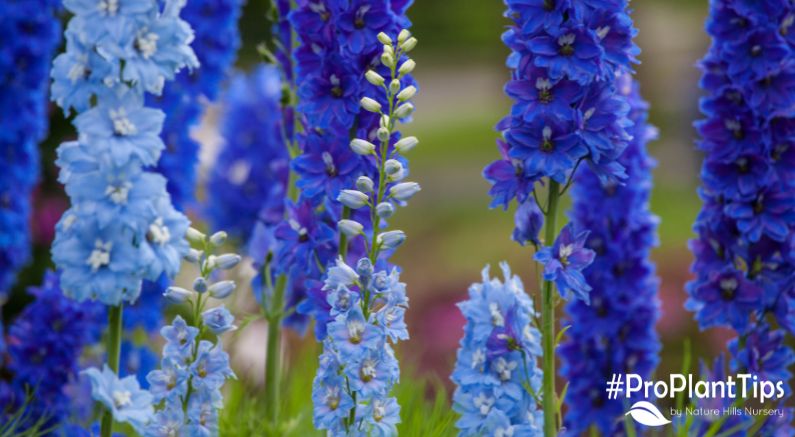
Tall and tightly packed blue wands that pollinators and hummingbirds adore, the dramatic Delphinium is sure to strut its lacy foliage and vertical flowers in your landscape!
Related to Hellebores and Monkshood, and a member of the Buttercup family (Ranunculaceae), Delphinium has a long history as a medicinal, for creating blue dye, with cultural and religious significance, symbolizing open and ardent love, lightness, and levity!
Learn about how to care for and enjoy July’s birth flower!
All About Delphinium
There are about 300 species of flowering perennial Delphinium in the family Ranunculaceae. Grown for their showy spikes packed full of vibrant florets, Delphiniums come in brilliant shades of blue, pink, white, and purple, and many are perennials, but some are biennials or some varieties may be annuals.

Native Larkspurs have been cultivated in English gardens since the 15th century and with breeding and cultivation, the large-flowering Delphinium came about! Native forms of this perennial can be found throughout the Northern Hemisphere and the many cultivars are a favorite of many gardeners.
Common names include Bee Larkspur, Lark's Heel, Lark's Claw, and Knight's Spur, Delphiniums also include a slightly different variation, known as Larkspur. Delphiniums get their name from the Latin for 'dolphin' which refers to the nectary at the base of each flower that resembles a dolphin.
The big flower spikes bloom from the base up, creating a tapering bloom full of flat, ruffled, and colorful florets that flower for a long time as a whole. The small black dot in the middle is known as the 'bee'.
The green basal rosettes have fine-cut, deeply incised foliage reminiscent of Japanese Maples with deep grooves along the midribs for a textured effect. These tall wands bring a whimsical and magical element to the landscape and can be towering focal points very quickly!
Using Delphinium In The Landscape
Delphiniums are perfect plants for adding tall, linear pops of color throughout the summer garden! Typically flowering from June to September, these put on a long-lasting display! Also available in pink, purple, and white, Delphinium includes some of the few 'true blue' flowers!
Smaller Delphinium varieties are fantastic planter thrillers that add height without taking up much space and are wonderful front-of-the-border accents and edging!
While taller varieties are dramatic back-of-the-border accents, in rows as backdrops, and in groupings as towering focal points among sunny garden beds and borders.
Delphinium are must-haves for the Cottage Garden, but are also at home in the mixed perennial border, or along pathways and walkways without worrying about them taking up too much space. They’ll especially show off when planted in front of a picket fence or evergreen hedge!
Not only are the flowering spikes super showy, but Delphinium flowers are fragrant and attract more than people to check out their impressive fat flower clusters! The fragrance attracts bees, butterflies, and even a few curious hummingbirds! Florists love them and Delphinium is a must-have for the pollinator border, and your cut flower garden!
Nature Hills Top 5 Favorite Delphinium!
We’re sure you can find your own favorite Delphinium plants, but here’s our Top 5 Favorites!

#5 Diamonds Blue Dwarf Delphinium
Featuring pink diamond-shaped dotted petals, the 2-foot tall flowering spires shoot up flouncy spikes of flowers ranging from electrified lavender to lavender blue. These perennials form mounds of heavily lobed, deep green leaves that are perfectly sized for tucking into any garden bed or border, or even containers for a dramatic blue vertical accent!
#4 Blue Lace Delphinium
Soft sky blue double blossoms packed along a soaring 5 to 6-foot tall wand that erupts from clumps growing only 2 feet wide! The Blue Lace features enchanting petals for bees and pollinators and enormous back-of-the-border specimens! Cold hardy in USDA planting zones 3 to 7, Blue Lace stands out head and shoulders above the rest!
#3 Summer Nights Delphinium
With true blue blooms and light green foliage, the Summer Nights Delphinium has airy spires like their Larkspur cousins and grows under a foot high and wide! The flower and foliage color combo is eye-catching, to say the least! Check out other Summer Delphinium series Delphinium like the white Summer Stars, the sky blue Summer Blues, and pale pink Summer Mornings for the full range of pretty colors available in this great series!
#2 Magic Fountains Delphinium
All of the Magic Fountains Delphiniums are incredible to behold! Huge, boldly-colored, tightly packed spires full of double cuppy petals, it's no wonder they’re high on this list! The Magic Fountains Dark Blue White Bee Delphinium royal purple-blue double flowers with white eyes are incredible back-of-the-border accents 2-3 feet in height. Magic Fountains Delphinium also includes Cherry Blossom with mauvy pink blooms and white eyes, or the White Dark Bee Delphinium with white petals and black dotted centers.
#1 NEW MILLENNIUM™ Purple Passion Delphinium
Supersaturated dark purple spires shooting up 4 to 5 feet in height, these showy double flowers are each accented by a white eye. With clumps forming 2-foot wide mounds, Purple Passion will stand up and stand out with impressive form and color! Just as cold hardy and sturdy as the rest, the incredibly bold color will garner attention from everyone and every pollinator around!
Caring For Perennial Delphinium
Delphiniums have the strongest stems to support those tall flowers when planted in full sun - 6 hours or more sun per day.
Delphiniums require moist, cool summers, and it is suggested that they be bought as a plant since it is difficult to grow them from seed. While short-lived perennials, the many off-shoots that form around the base of the main plant can be transplanted or encouraged in place and enjoyed year after year!
These perennials do best in moist, well-drained soil that is organically enriched. Create raised gardens or berms if you have poor drainage. Delphiniums cannot tolerate wet saturated soil, especially during the winter months., so water new plants regularly using the Finger Test to help them get established and continue to provide supplemental water during high heat and drought.
- Get your new Delphinium off on the right foot with Nature Hills Root Booster!
- Deadhead stems to the ground as flowers fade to encourage a rebloom
- Prune Delphinium leaves back in the late autumn after several killing frosts.
- Provide regular fertility in the spring and early summer
- Give taller varieties support if your area has strong winds and storms
- Important to provide a 3-4 inch deep layer of mulch over the root system (not covering the crowns)
Deer and rabbit-resistant because of their thick leaves and possibly because of their strong flavor. There are few pests and diseases that attack these hardy perennials!
Dive Into Growing Delphiniums!
Bold blooms for the back of your garden borders, Delphinium adds an element of surprise and mystery to your landscape beds!
Bring this flower from antiquity to your yard today and see why it’s beloved by so many!
Happy Planting!

