
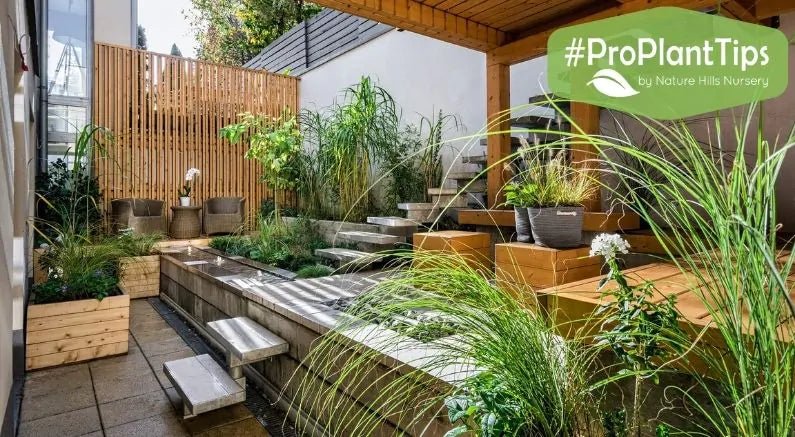
Showcase your style with these easy tips for a dynamic outdoor container garden display that looks amazing throughout the year. It's actually a lot like buying a new couch!
Here's how to create a stylish setting in winter, spring, summer and fall! Plant your garden containers with perennials and trees...you'll have a focal point that performs for you year after year.
Go for easy-breezy romantic pink flowers like Hydrangeas and Roses massed on your front porch. Or, enjoy the bright-colored foliage of Japanese Maples trees in large pots near a seating area in part shade.
Long-lasting hardy perennial container gardens work all year-long and will save you money. Ensure the containers have good drainage, high quality potting soil and follow the directions to apply fertilizer.
Here's how to create a perennial garden planting that works in all seasons, no matter if you have a tiny balcony, townhome or a suburban lot. Just like shopping for couches, start by studying your space.
First, Get to Know Your Growing Conditions
How much room to grow will you have to work with? Take measurements of the depth, width and height of your available space...especially if you want a hard-working solution to decorate a smaller area.
Can you choose an "overstuffed sectional" or do you need to look for a "loveseat"? If you have a balcony to decorate, you'll also need to consider the weight of your overall garden display.
Spend time thinking about the goals for your planting. Maybe you want to expand the livability of a tiny balcony with privacy screening...or maximize the visual impact of an outdoor entertainment area.
Create a budget for your project, as that will definitely guide your choices. Limited budgets simply mean that you'll implement your grand plan in phases...so get creative to save money!
Understand the Genius of Your Space
Plants have different care requirements. How cold are your winters? Are your summers hot and dry or is the humidity off the charts?
Type in your Zip Code on any of our plant product pages. Look at the top of the Plant Highlights for our Zone Finder to see which hardiness Zone you live in.
Plants that are rated for Zones warmer than your hometown can still be enjoyed for a single season as an annual for a single season. You might be able to winterize them in a sheltered spot for reuse next year, too.
Zone hardy plants for your area can be left outside in winter. This gives you a huge advantage when you want a container garden that works all year-long.
Check to see how much sunlight your selected spot receives. Full sun means six or more hours of direct light a day; while full shade means no more than two hours of light a day.
Containers in full sun will likely need more supplemental water; and small containers dry out faster than larger ones. Consider collecting rainwater as part of your overall design...plants love it!
Now, It's Time to Add Creative Structure
Garden styles—like couches—are a reflection of their owners. After all, couches come in purple velvet, leather or floral chintz for a reason.
What is your garden personality? Take a look and see what best describes the look you want to achieve:
- Vibrant colors and a fun and funky vibe
- Elegant with a high-end feeling of sophistication
- Laid back country grace and charm
- Over the top, unforgettably romantic
- Sultry, dark and mysterious
- Spare and streamlined with clean architectural lines
- Practical, yet brimming with vital foodstuff for you and your family to enjoy eating
The key to a container garden that works all season is selecting the "hardscape", which includes the pots. You might also want to successfully incorporate props into the scene for a look that lasts through the winter.

Do you have a passion for the past? Look for old ladders, bicycles, wheelbarrows, wagon wheels, toy wagons and so much more to set the stage.
Urban objects also make incredible accents. Scour architectural salvage shops for columns and plinths to use as effective plant stands or to add a vertical element.
Garden artwork doesn't need to be huge, heavy or expensive to make a big impact. Follow your fancy on these engaging style elements, which can be changed out each season...like throw cushions on your couch!
Planters come in all shapes and sizes, too. Materials range from budget-friendly polyurethane foam and resin; to wooden barrels to brushed aluminum...and no one says you can't mix and match.
Amass a meaningful collection over time; or seek out a trio of pots offered in a range of sizes. If you are handy...why not try your hand at creating custom "hypertufa" troughs for the cost of a few bags of concrete, perlite and peat moss?

With Pinterest as an inspiration, anything goes to bring your vision to life! People are drilling out stumps and cross-stacking concrete blocks to fill the holes with plants.
Incorporate privacy screening into your plantings with DIY trellising. Use a fun outdoor mirror to brighten a dim corner,
Steal ideas from other genres to work in a fresh new way. Have a classical Greek statue hold a hanging Blueberry plant over her arm for a unique twist on an Edible Landscape.
Try a prefab vertical planting ladder on the side of your front door. Or group a series of wooden half-barrels along your driveway to grow a Butterfly Garden.
Put together a balanced composition that works at all levels. Hanging planters, wall planters, and ground-level planters give plenty of opportunities to keep your eyes moving over the design.
Rely on one enormous planter for a focus point. Or group several patio containers together for a versatile display.
Adding durable elements make all the difference throughout the seasons. Vertical accents like tuteurs, towers and trellis look great in winter, and add height in a narrow footprint.
Don't forget the exterior lights! You'll love extending the appeal into the evening hours, and you've got so many choices to fit your budget.
You can also go modular by using several containers, and keep them on plant caddies with wheels. Then, arrange your pots as each plant takes its turn to shine.
Choose a potting mix that works for your selected plants. Blueberries need an acid-loving plant mix, for instance.
Study our #ProPlantTips on the product page, or in our blog or YouTube channel for more information on the soil requirements. Email us at info@naturehills.com with questions, too!
Plants Bring it All Together
Now you understand the growing conditions you can offer, and have assembled the hardscape components together. It's finally time to look at all the lovely plants we offer at NatureHills.com!
The key to a successful year-round container is to consider the seasons of interest. Winter interest plants add structure and privacy, spring bulbs bring welcome color, summer blooms spice things up and fall color or berries round out the display.
If your budget allows, you can follow the footsteps of commercial property and shop to switch plants out regularly through each season. We recommend that you start with a more permanent "Thriller" like one of our evergreen topiary.
Plant your favorite perennials to fill in the edges. Select both late spring bloomers and some that shine later in the season.
Don't forget Ornamental Grasses! You'll love their modern lines which look good from summer all the way through winter!.
Keep things fresh with small plants added to spill over the sides of the pot. Check out our Groundcovers and Vines for beautiful blooms and winter interest!
Spring-flowering bulbs can be tucked into just about any container in fall! Add successive spring bulbs from early Hyacinth and Snowbells to Tulips.
Best Evergreens for Containers

Dress up long-lasting containers with cold-hardy evergreen trees and shrubs that are handsome, steadfast and durable. This durable option will deliver year-long color and can be dressed for the Holidays with lights and outdoor ornaments.
Sky Pencil Holly provides a vertical accent, and is a great choice for balcony containers. It's narrow profile fits beautifully in a small space partnered with a dramatic mix of Blackout Coral Bells and Silver Heart Brunnera.
Dwarf Alberta Spruce can be used naturally as a green pyramid; or, take advantage of the expert care we take with our line of fanciful topiary. This tree is a spectacular contrast to golden groundcovers like Golden Creeping Jenny.
Specialty, slow-growing evergreens like Green Penguin Dwarf Scots Pine adds a fun pop of personality. Papoose Sitka Spruce would make a wonderful companion in a matching pot, wouldn't it?
Even trees that get huge start small, and most can be enjoyed for years in containers. Look for dwarf options like Baker's Blue Colorado Spruce for the best results!
You can also choose broad-leaved evergreens for a brilliant display. Colorful Kaleidoscope Abelia would make a fabulous addition to your patio or porch, and don't forget SUNSPARKLER Angelina's Teacup Sedum to polish the edges.
Tough Yucca adds a sculptural accent. Include Color Guard Yucca as a showy backdrop for Apricot Drift ® Groundcover Rose...or keep it in it's own single species container.
Best Ornamental Grasses for Containers
Ornamental Grasses look great as single species containers, but the pots must be deep enough to accommodate their roots. Prune them in spring, then watch them rebound for a natural look you'll appreciate for years.
Stay cool with the steely-blue tones of The Blues Little Bluestem Grass. Let petite, vivid Boulevard Alaina Clematis drape down the side of the pot and clamber through the grass.
Keep things crisp and clean with Karl Foerster Feather Reed Grass. They'll pair well with the showy foliage of Cutting Edge Foamflower and extended bloomers like Little Goldstar Black-Eyed Susan.
Bring motion to your space with Northern Sea Oats Grass. Contrast their grace with sturdy Chocolate Chip Ajuga and Alma Potschke Aster.
Best Shrubs for Containers
Who can resist the bold charms of shrubs? Many of our best-selling shrubs make incredible "Thrillers" for outdoor containers.
Consider them a family pet for a long-lasting love affair. Seek out dwarf varieties with petite mature size for the best results over time...although you can certainly prune to keep the size in check.
Welcome spring with the brightly-laden arched branches of Show Off® Sugar Baby Forsythia.Pair it with evergreen foliage interest Emerald 'n Gold Wintercreeper and flowering Creme Brulee Coreopsis.
Perhaps we're biased, but nothing beats the smell of Dwarf Korean Lilac! Complete the look with gorgeous patio Boulevard Sarah Elizabeth Clematis.to add delicate swagger.
Add long-lasting fiery color with Black Diamond® Red Hot® Crape Myrtle kept short with pruning. Use a marvelous contrast like fuzzy Helene Von Stein Lambs Ear to fill around the base.
Make your favorite compact Hydrangea a "Thriller" for a summertime accent. Here, we've filtered the search results by Height to select some fabulous cultivars for container culture...enjoy!
Best Fruiting Plants for Containers

People all across the country are literally hungry to grow fruiting plants for their families. Although it's not easy to keep up with this demand, our growers take pride in helping you make homegrown fruit part of your life!
Columnar fruit trees are natural dwarves that stay quite narrow. They'll add a vertical accent, flowers and delectable fruit!
Naturally small fruiting trees and bushes fit very well into containers. You can also prune for size control using summer pruning techniques!
Be sure to look at our High Density planting blogs and videos for tips and tricks. These days, anyone with access to sunshine can produce a harvest to enjoy with family and friends!
Best Perennials for Containers

Use a series of containers to keep a single species planting of native plants for a fresh and modern look. Who says you need to own your home to plant a Butterfly Garden?
Look for Extended Bloom perennials to create a Cottage Garden in containers. Early season Blue Hill Salvia pairs beautifully with mid-season Pocket Full of Gold Daylily and late season Sapphire Aster.
All of our drought tolerant, heat tolerant Lavenders last a long time in pots with plenty of drainage holes and full sun. Start a collection of these lovely plants for marvelously fragrant flowers and gray-green foliage.
Shade or partial shade is an environmental challenge. Luckily, we offer a plethora of shade loving options to choose from...Hosta, Heuchera Coral Bells and Astilbe are some of your choices!
Try a color scheme for a restful outdoor experience. Moon Gardens feature pale blooms that catch the moonlight...kick back and enjoy your space!
