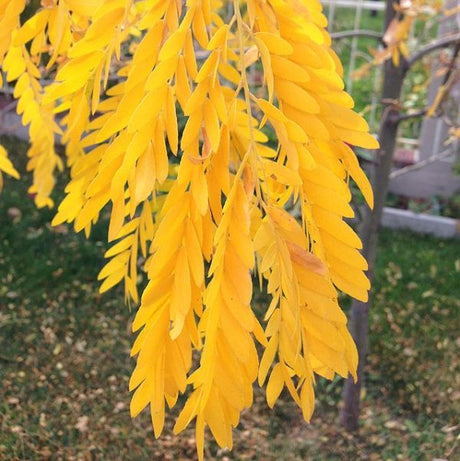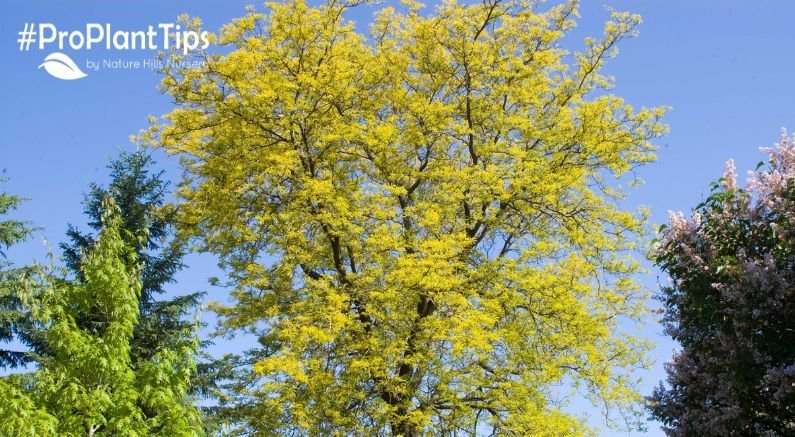
Honeylocust Trees are in the Gleditsia Genus and are well known for their fine-textured, tiny oval compound leaflets that cast light, dappled shade! Honeylocust Trees (or as some call them Locust Trees) are the perfect urban tree, tolerating compacted soils and tough urban conditions!

Similar to the Black Locust Trees is the Robinia Genus, the main difference is that the Black Locust has a very fragrant and showy flower display in the spring, whereas the Honeylocust blooms are not quite as prominent, though they are fragrant!
In the family Fabaceae, Honeylocust and Black Locust trees are completely different genera, even though they share a common name. Black Locusts are colonizing trees with showy, fragrant flowers that resemble Wisteria flowers, which are creamy white or purple.
Either way, pollinators will love both these trees and their scented flowers!
We also grow several different Honeylocust cultivars that are not only thornless, but also a few can be sterile and produce none of the long purplish brown seed pods that can be up to 18 inches long and look like long, flattened beans.
All Locusts are extremely hardy trees and fast-growing in a range of USDA planting zones from zones 4 and up.
Read on to learn more about the many perks that these fine-textured deciduous trees have in store for your landscape!
Toughest Shade Trees On The Block
Gorgeous, airy trees, the Honeylocust isn’t just a pretty face!
Honeylocusts can tolerate urban conditions and pollution, poor soils, compacted soil, alkaline soil, heat, and drought - even salted roadsides and saline conditions!

Honeylocust roots go deep, so they generally won't bother pavement, sidewalks, driveways, or patios, but give them at least 15 feet of space away from your home or the concrete.
Honeylocust are fantastic Shade Trees that cast dappled shade, making them ideal as lawn trees because lawn grass won’t get shaded out beneath their broad limbs! Even perennial and part shade shrubs do fantastic beneath their limbs! This is because Honeylocust trees offer filtered shade rather than dense shade, which makes them perfect as a focal point in the center of a vast yard!
Many Locust trees can grow to a grand size, creating a big visual impact on nearly any landscape! With a glowing fall color to round out the end of the growing season. Use these trees to cool the sunny side of your home for reduced cooling costs! Set up a hammock or seating area and entertain or relax in the shade!
Honeylocusts are also very hard-wooded and tolerate windy, open, exposed sites well! Making them ideal for use in your Windbreak and shelterbelt hedges!
The ferny leaflets appear on pinnately compound leaves, giving Black Locusts and Honeylocusts an airy and fine-textured appearance because the compound leaflets are further divided into smaller leaflets, known as bipinnate.
These tiny leaflets don’t drop in the fall as one large leaf; instead, each leaflet drops on its own, making fall-clean-up a snap!
As a Legume family member, Honeylocust and Black Locust Trees will fix nitrogen in the soil, which helps improve poor soils!
Nature Hills Nursery’s Favorite Honeylocust and Locust Trees!
Honeylocust trees excel where others fail! Browse our inventory of hardy, fast-growing ornamental trees for your landscape!
Here are the top sellers at NatureHills.com!
5. Purple Robe Locust Tree

The Purple Robe Locust Tree has unique twisted branches and purple flowers that resemble Wisteria blooms. Super hardy and drought-tolerant with a brisk growth rate of 2 or 3 feet of growth each year! Bees and beneficial insects love the flowers as much as you will! Each spring, the leaves emerge reddish bronze before maturing to dark blue-green.
This improved Black Locust variety is much less thorny than its predecessor, but keep an eye out because this tree can sometimes have a few thorns.
- Fragrant Purple Wisteria-Like Blooms
- Dark Blue-Green Foliage Emerges Bronzy Red
- Very Fast Growing - 2-3 Feet A Year Once Established!
- Growing Zones 4-8
- Mature Height 30 - 40 feet
- Mature Spread 20 - 30 feet
4. Twisty Baby™ Black Locust Tree

The Twisty Baby™ Black Locust features white fragrant spring flowers, and a fast-growing, open, airy canopy is a big bonus! Its twisting, zig-zag branches are decorated with gorgeous, fragrant white flowers that bloom in the spring. Twisty Baby™ features fine-textured foliage that emerges soon after the blooming blossoms! Pollinators flock to these fragrant, dripping Wisteria-like blossoms!
Not only do the branches have a contorted look, but there is some curling of the mature leaflets, which gives it its unique look!
- Twisted Contorted Growth
- Fragrant White Wisteria-Like Flowers
- Dwarf Sized Tree
- Blue-Green Leaves
- Growing Zones 4-8
- Mature Height 12 - 18 feet
- Mature Spread 12 - 15 feet
3. Black Locust Tree

Native to the Appalachian Mountains of North America, this native hardwood tree has many valuable uses as a cash crop, as an edible ornamental (flower fritters!), Acacia Honey, and a fragrant shade tree! So farmers, homesteaders, and entrepreneurs should take note! The native Black Locust trees (Robinia) typically have small, sharp thorns on smaller trunks and branches, plus 4-5 inch long seed pods.
It's extremely adaptable to almost any soil type. It grows in either wet or dry soils. Try this tree for locations where other trees may have failed. It's tolerant of urban pollution and is drought and cold-hardy.
- Beautiful Light Green Oval Leaflets
- Growing Zones 4-9
- Mature Height 70 - 80 feet
- Mature Spread 25 - 30 feet
- Extremely Tolerant, Adaptable, Wet/Dry Soils & Drought
- Fragrant White Spring Flowers - Fantastic Honey Tree!
2. Shademaster Honeylocust Tree

With nice green leaves spring through the summer, and a lovely golden-yellow in the fall, these are ideal lawn trees that cast light shade over large areas 25 - 40 feet wide when mature! But there is no worry that this shade will kill your lawn. The long, odd-pinnately compound leaves are almost fern-like! Plus, being a seedless variety, Shademaster will remain mess-free! Your pollinators will seek out the fragrant greenish-yellow flowers in the spring!
Honeylocusts are extremely hard-wooded and hold up extremely well to ice storms and wind damage throughout USDA growing zones 4 to 9!
- Thornless & Seedless Cultivar of the Hardy Native!
- Fast-Growing Open, Airy Rounded Canopy
- USDA growing zones 4-9
- Mature Height 50 - 75 feet
- Mature Spread 25 - 40 feet
- Pollution Tolerant, Compacted Soils, Urban Conditions & Salt-Tolerant
1. Sunburst® Honeylocust Tree

The brilliant shock of color that only the Sunburst® Honeylocust offers your landscape is enough of a reason for this tree to be number one! This tree is a tough cookie throughout USDA growing zones 4 to 9. Shrugging off compacted soil, clay soil, urban pollution, high heat, and needing little care! A hard-wooded tree that tolerates ice storms and wind with few problems!
But there’s more! Sunburst® Honeylocust is a seedless male clone for mess-free landscaping with no seed pods in the summer/fall months!
- Thornless & Seedless Cultivar
- USDA growing zones 4-9
- Fragrant Spring Flowers
- Sunny Yellow New Leaves in Spring
- Bright Green Foliage All Summer
- Gold Fall Color
- Mature Height 35 - 45 feet
- Mature Spread 30 - 40 feet
Other varieties include:
- Thornless Honeylocust Tree has bright green foliage and early yellow fall coloration
- Imperial Honeylocust Tree has no surface roots or prickly thorns!
- The thornless Skyline Honeylocust Tree has a beautiful pyramidal form
Caring For Honeylocust Trees
Give Honeylocust trees plenty of sunlight, at least 6 hours a day, for the best growth and vigor.
Plant your new Locust tree in any well-drained soil with regular moisture access during their first year. We recommend you plant your tree with the lifelong symbiotic support of Nature Hills Root Booster. After they are established, Honeylocust only needs supplemental watering during extended periods of drought.
Top-dress the soil with a 3-4 inch thick layer of arborist mulch - especially when planted in the lawn. Create a buffer zone extending 3-4 feet from the trunk to protect the bark from mower and weed-whacker damage.
Low-maintenance trees only pruning when cool and dry, and keep any suckers removed from the base. Keep the trees stress-free for a healthy, long-lived tree.

Find Lovely Honeylocusts At Nature Hills!
Fine-textured and bright foliage, the carefree and hardy Honeylocust Tree will fit right into any landscape, no matter how tricky it may be!
Think of Honeylocusts as your fix for all your property's problem areas - and they look good doing it! Get lasting shade and legacy with a Honeylocust today at Nature Hills Nursery!
Happy Planting!