
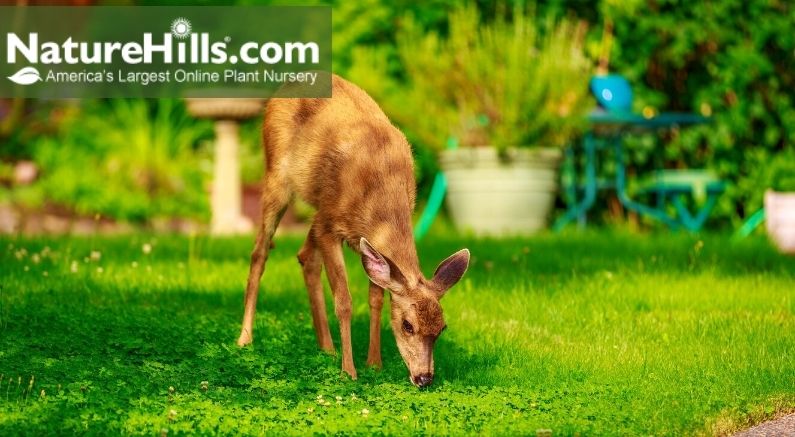
If you live in the southern growing zones and are constantly struggling with nearby deer killing your freshly established plants, we have the top deer resistant plants for you to add to your landscape.
Never have to relive the days of broken branches, eaten flower blossoms or exposed tree bark caused by deer.
We’ve outlined below five plant varieties that are known to be specimens deer don't particularly enjoy eating and that strive in the southern growing zones:
Top 5 Deer Resistant Plants For The South
Crape Myrtles

If you’re looking for vibrant garden color, look no further than Crape Myrtles. From purple and pink to red and white, along with every shade in between, these garden favorites are known for bringing life to the flower power party.
Each late summer extended into fall, their bright colors are showcased and that’s when the neighbors just can’t look away.
There is no end to what you can do with Crape Myrtles when it comes to outdoor design! Space a few apart for a solid screen along your property line. Plant a single specimen at the corner of your home for that added curb appeal. Or use them in a garden bed as the focal point.
We love to grow Crape Myrtles in two ways -- tree form and shrub form! Some varieties grow on a single stem, making them fantastic small ornamental trees for the yard. Other varieties sprout multiple stems and are trimmed down to create excellent looking shrubs that are easily maintained.
Which way is your garden style? Grow both to find out!
The best part is deer find Crape Myrtles to be less than appetizing. Although we think they are gorgeous, deer aren’t amused and will find their food source elsewhere in the South. So, that means embrace the perfectly grown blossoms each year without a worry!
Our Most Popular Selections:
- Black Diamond® Purely Purple™ Crape Myrtle (Lagerstroemia BLACK DIAMOND 'Purely Purple')
- First Editions® Plum Magic Crapemyrtle Shrub (Lagerstroemia 'Plum Magic')
- Black Diamond® Crimson Red™ Crape Myrtle (Lagerstroemia BLACK DIAMOND 'Crimson Red')
Perennial Sage Selections

The strong scent of Russian Sage Bushes is not one that deterring deer opt to eat. These wonderful semi-woody herb plants provide a unique and pleasant aroma that most gardeners will use in their homes as a natural fragrance.
Not only will these bushes work hard indoors as a scent, but they will also work wonders in the landscape. The delicate grayish foliage pairs well with just about any perennial, ornamental grass, or even succulents.
In fact, these Russian Sage Selections are a top pick for xeriscape gardens! They love the southern heat and can withstand being planted in full sun.
Trim them down to serve as an elegant ground cover or let them free as a blooming bush. Nature Hills likes to pair our Russian Sage with a garden bed full of large flowers. Or, line a walkway that kindly greets guests with purplish blue flowers.
Regardless of how you decide to style them, Russian Sage Selections won’t have a problem with pesky deer using them as a snack!
Our Most Popular Selections:
- Russian Sage (Perovskia atriplicifolia)
- Denim 'n Lace Russian Sage (Perovskia atriplicifolia 'Denim 'n Lace')
- Little Spire Russian Sage (Perovskia atriplicifolia 'Little Spire')
Japanese Cedar Trees

There is nothing more mature looking than a few Cedar Trees in the landscape, specifically Cryptomeria japonica cultivars! These evergreen trees have a slight hint of a fresh fragrance that we’ve all learned to love and that deer hate.
We love this genus of Cedar Trees because of their ability to provide a ‘soft’ natural setting to any yard. Whether it’s full sun or part shade, your Cryptomeria trees can give you that soft privacy screen-- perfect for hiding the neighbors and creating a sensational backdrop.
Even block off a busy nearby road or give yourself a break from the wind using these Cedar Trees!
You may find a few local songbirds perched within the branches, but never find deer nibbling on the handsome green foliage. Look forward to growing that wonderful Cedar aroma with a few of these cultivars established in the yard!
Our Most Popular Selections:
- Cryptomeria Yoshino (Cryptomeria japonica 'Yoshino')
- Dwarf Japanese Cedar (Cryptomeria japonica 'Globosa Nana')
Cherry Laurel Bushes

With all that being said, they still don’t catch the eye of deer!
Use your Cherry Laurel Bush as an established low hedge that lines your driveways, pathways and more. They can also serve as garden bed anchors that provide four seasons of interesting backdrops.
Build the ultimate pollinator friendly garden with a few Cherry Laurel Bushes mixed in among other perennials and roses too. The uses are almost endless and deer will find their food elsewhere.
Our Most Popular Selections:
- Zimmerman Cherry Laurel (Prunus laurocerasus 'Zimmerman')
Golden Rain Tree

You’ve seen it spread far across the southern United States because they can’t get enough of the heat. With four seasons of incredible interest, the Golden Rain Tree definitely has a reputation that precedes itself.
In the summer, its bright yellow flowers will make you stop and stare while being pleasantly blessed with a heavenly fragrance! The fall brings an artistic
display of orange and yellow leaves followed by the winter gracing a landscape with attractive bark.
The Golden Rain Tree is an effortless accent specimen that doubles as a small shade tree. Plant a row of them along your property line for an instant backdrop that cancels out noise. Or, use it as a single specimen in a rock garden or along a walkway.
This tough, urban savvy tree isn’t bothered by deer and we predict it’s because of the fragrance that tags along with the yellow flowers. The Golden Rain Tree is a MUST for southern planting zones!
Not in the Southern USDA hardiness zones? Take a look at our blogs covering Deer Resistant Plants For the North, Deer Resistant Plants For The East and Deer Resistant Plants For The West.
Although there are several plants that seem to be deer resistant, Nature Hills would like to state that there are no 100% deer proof plants-- instead, there are only plants that deer seldomly bother as compared to others.
Keep in mind that if the deer populations are increasing and their natural food sources are limited, deer are a lot more likely to browse on any plant of their choice, regardless if it is ‘deer resistant’ or not.
Furthermore, if you are adding a brand new plant into a certain area, deer are far more inclined to sample it just to see if they like it or not. Because of this, Nature Hills suggests spraying a deer repellent, like Bonide Go Away Deer Repellent, on all new plants.
This reminds the local deer that they don’t like the taste of your new plant.
Maybe your new trees have already had deer rub their antlers on the trunks in the fall of the year. If so, your tree is now very vulnerable and suggest reading How To Protect Trees From Deer Damage!
With the above 5 plants in your southern garden, never bat an eye at wandering deer again!
Happy gardening!
