
Complete Guide To Planting & Growing Iris Plants!
In need of a flower that is easy to plant, easy to care for, and even easier to enjoy? Look no further than the lovely and elegant Iris!
- Why Choose Iris Flowers For Your Garden?
- 1. Bearded Iris: The Garden Show-Stopper
- 2. Dwarf Bearded Iris: Perfect For Small Spaces
- 3. Louisiana Iris: The Water-Loving Beauty
- 4. Japanese Iris: For Large, Showy Blooms
- 5. Siberian Iris: The Low-Maintenance Beauty
- Understanding Iris Types: Rhizome vs. Bulbous Iris
- Start Your Iris Garden Today
Why Choose Iris Flowers For Your Garden?
The amount of variety that is held within an Iris flower is unstoppable! You'll find an assortment of sizes ranging from short and petite to long and tall. These Iris bulbs even have various bloom seasons.
And, a crazy amount of different color shades that carry an eye-catching vibrance. Maybe that's how they got the name 'Iris', which stems from a Greek word used to describe a rainbow.
But with all that comes a large collection of Iris varieties to choose from, and that can be overwhelming. In fact, there are an upward of 300 species!
The choices seem endless, and the success in gardening is all about the choices we make! Since this infamous flower hosts so many possibilities, one is sure to be your match!
With that being said, Nature Hills is here to guide you with ease to finding the Iris of your garden dreams!
Follow along as we highlight the top Iris flower types below:
Read How To Care For Iris Here
1. Bearded Iris: The Garden Show-Stopper

Let's start the show off strong with one of the most commonly known types, the Bearded Iris. You may be able to guess where it gets its name from by simply spotting one in a flower bed.
It's also commonly known as the German Iris or the Flag Iris.
What Makes Bearded Iris Special?
Uniquely, downward-facing petals that have ruffles along the edges create a fuzzy beard-like scene. Or kids like to think the flower is sticking its tongue out at them, so don't be alarmed if your child is doing the same back!
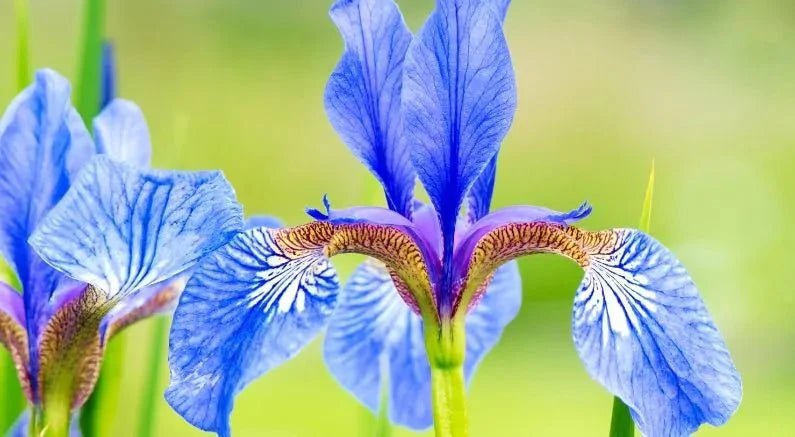
Normally, 3 of these drooping petals will be present and are often called falls, while the upright petals are called standards.
Growing Bearded Iris Successfully
These Iris plants are germanica cultivars and can be grown exclusively for any color scheme you may desire. Plant this variety in full sun or partial shade to achieve rich colors of blue, purple, yellow, pink, red, white, and every shade and color combination in between.
Gardeners love to use these as cut flowers because of their colors! Imagine waking up to a colorful arrangement on your nightstand or using it as a centerpiece in the dining room. There is no room that this Iris can't liven up.
Bearded Iris Care Tips
Be sure to remember that the Bearded Iris group also has subdivisions, which can get confusing! These include:
- Tall Bearded Iris
- Intermediate Bearded Iris
The only difference is the mature height at which the Iris grows. Nonetheless, you'll still obtain those rare drooping petals.
Best planting times: You can either plant them in the fall or in the spring. For the best care, they love a sunny, well-drained soil. However, if you have clay soil, acidic, sandy, or loamy soils, they will tolerate that too.
Pro tip: To encourage reblooming, we recommend removing the spent flowers.
Bloom season: Come mid-spring and lasting through late summer, your garden will be graced with Bearded Irises that make your neighbors 'Ooo' and 'Ahh' over!
2. Dwarf Bearded Iris: Perfect For Small Spaces

Just like the above group, but shorter! The Dwarf Bearded Irises include flowers that don't grow as tall as their friends. In fact, this type even has a subdivision called miniature dwarfs that can grow to be less than 8 inches high.
Why Choose Dwarf Bearded Iris?
They are little petal powerhouses that illuminate a landscape border or rock garden! What's not to love? The best part, Dwarf Bearded Irises multiply with ease and swiftness. So you can populate many areas of your yard with an investment of a few plants.
Container Gardening With Dwarf Iris
A pair of container gardens chock-full of these Iris bulbs is a friendly sight for guests to see when visiting. Fair warning-- the several compliments can be overwhelmingly positive and never-ending.
Also an Iris germanica cultivar, the Dwarf Bearded Iris is well known and a fan favorite!
3. Louisiana Iris: The Water-Loving Beauty

The states of Florida, Arkansas, Mississippi, and, yes, you guessed it, Louisiana, commonly see this Iris grow in the wild.
Natural Habitat and Growing Conditions
Typically found growing near bogs, roadsides, or in ditches, this bulb thrives in any low area of the garden that would retain moisture. So, if your rain garden or pond is missing a little splash of color, this water-loving Iris is the one for you.
Growing Louisiana Iris
Coming from the south, the Louisiana Iris prefers to stay warm. Therefore, if you're in a zone that expects freezing temperatures, apply a3-4 inch deep layer of mulch for an extra shield. They love a nice layer of mulch after planting to:
- Prevent weed growth
- Buffer the soil temperatures
- Help make plenty of new roots after planting
Not to mention, the mulch will help retain water that these bulbs desire more than anything else. Be sure to frequently water to ensure consistent moisture.
4. Japanese Iris: For Large, Showy Blooms
The Japanese Iris isn't as well-known as its fellow friends, but gardeners who are seeking out large blooms should definitely add them to the landscape blueprints.
Special Growing Requirements
They thrive in wet conditions, so don't mess with that well-drained soil stuff. Instead, place your Japanese Irises in areas that remain damp and moist.
Best Planting Practices
We know you'll appreciate the more refined and less conspicuous petals that top the stems. In fact, this beardless Iris features huge orchid-like flowers that are a delight to see. They pair well with any mass planting or garden border!
5. Siberian Iris: The Low-Maintenance Beauty

Well, they lack the fuzzy, downturned 'beards'. However, they do still have 3 petals that grow down, while the other grow up. Instead of the foliage turning into ratty waves when done blooming, this Iris maintains elegantly waving green foliage to keep the visual interest going past the petals! Many gardeners will even use them as living mulch or ornamental grass substitutes.
Planting and Care Schedule
To enjoy blooms come spring, plant this Iris in late summer or fall. However, if you miss out on the fall planting season, no need to fret! The Siberian Iris can be planted during the spring as well, just don't expect blossoms that same year.
Watering and Maintenance
You'll find these flowers like the soil a little moist when they are first getting established, as they are rarely bothered by rots or borers. Once established and healthy, water regularly when drought conditions occur.
Understanding Iris Types: Rhizome vs. Bulbous Iris
In contrast to the hundreds of species, countless colors, endless types, and various heights, there are only 2 major groupings of Irises. Those would be: Rhizome Iris or Bulbous Iris.
What Are Rhizome Irises?
Rhizome Irises grow from thick fleshy rhizomes that sprout right at the soil surface. They are underground roots that grow horizontally through the soil. While doing so, they send up stalks along the way. Most often, they resemble irregular or flattened shapes with thick stems. Rhizomes continue to grow slowly underground, which is how the extreme propagation of some plants, such as bamboo, takes place.
What Are Bulbous Irises?
Bulb Irises also go underground, but are modified buds with scale-like leaves surrounding them. They don't grow horizontally, however. This is the key difference. You'll notice the bulb Irises start out are globe-shaped at the root, unlike the irregular shape of rhizomes.
Start Your Iris Garden Today
With all the possibilities of Irises, there is really no going wrong. Your flower garden will be easier to plant and care for, while still being diverse.
Start finding the Iris of your dreams!
Happy Planting!

