
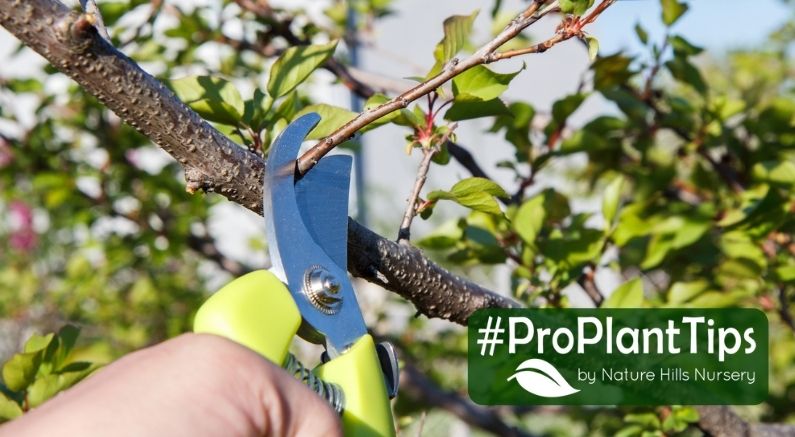
There are many reasons for pruning fruit trees in the garden. Pruning fruit trees stimulates growth by limiting the number of buds that the tree has to grow. Directing growth, energy and nutrients into the fruiting limbs.
Pruning trees can improve the structure, plus thinning out the fruit will result in better quality and larger fruit. Not to mention keeping your trees looking attractive!
Fruit tree pruning can be dwarfing and may be used to control the size of the tree as well, a bonus when you have a smaller lot and not enough room for a standard-sized tree.
Pruning fruit trees should almost always be done during the winter or dormant season. This is when the leaves have all fallen and the structure is more easily identified so you can see what you are doing.
Fruit tree pruning should take place annually, beginning in late winter or after flowering. There are two stages of pruning that take place during the life of a fruit tree to keep it bearing fruit for the long haul.
Training
The two most common fruit tree pruning orientations are the central leader and the open center. The shape that will work the best depends on the type of fruit tree being grown. Once this framework is established, maintenance pruning is easy to perform on an annual basis.
This consists of:
- Cutting back certain branches in order to maintain the desired shape.
- Thinning out the fruit, which will provide room for larger, healthier fruit.
- Removing lower branches along the lower trunk, as well as any suckers coming up from the roots. This pushes all the root’s energy into the crown.
- Pruning the crown of the tree is used to thin some weaker, less productive branches and to shorten up any branches for ease of harvest or maintenance.
It is a good idea to prune your fruit trees when they are dormant in late winter. There’s definitely a method to it, but it isn’t rocket science!
The type of tree and the look you’re going for will ultimately determine which of these pruning styles to adopt. The two main types of pruning styles are:
Central Leader Pruning:
A strong central leader is what gives most trees their height and iconic, Christmas tree shape. Removing competing leaders and prune off water growth, and crossing branches will maintain the shape of your tree.
Best done for apple trees, pears, cherries trees, and some plums, leader cutting on a young tree encourages new lateral growth and branches, preventing a young whip from becoming a tall, skinny single stem with no branching. However, cutting the main leader on an older tree will dwarf or stunt your tree.
Open Center Pruning:
Pruning to open the center of the crown, also called vase form, allows sun and air circulation in the center of that crown, as it does help fruit production during the growing season.
As part of a management system for heavier fruit such as Nectarines, Peaches, Apples, and other fruit tree crops, it may allow the tree to hold the weight of the fruit. It also makes it easier to harvest, and of course, as mentioned above allows more sun and air circulation which possibly reduces the amount of disease susceptibility.
Maturity
Once mature, a fruit tree’s annual pruning and maintenance involves thinning out the fruit, and ensuring that all branches and leaves have direct access to sunlight for most of the day. Both winter or early spring pruning have specific types of pruning chores to be done.
When pruning fruit and flowering trees in most cases, enjoy the spring flowers, and when the bloom is done it is the safest time of the year to prune without removing that year’s fruit.
Fruit trees form their flower buds and fruit on ‘fruit spurs’ so be sure to only remove these when there are too many in a cluster, when they are damaged, or diseased. Late spring or summer pruning involves:
- Thinning out the canopy of your tree maintains air circulation and lets sunlight inside to eliminate fungal and other issues from within.
- Removing small, malformed, or excess fruit, forcing all energy into just a few fruits per branch for larger, healthier crops, versus lots of very tiny fruit.
- Reducing branching where too many sprouts emerge from the same node, reduces breakage and focuses growth into the one branch you leave behind.
- Suckers growing from the base can be removed at any time because they, and water growth, sap the energy and strength from your tree.
In late winter, before you see new spring growth, is the best time to prune for the following issues:
- If there are some large limbs that may need to be removed, you might want to prune them when dormant in late winter.
- Remove any branches growing between your established framework that will crowd or clutter the interior.
- Maintenance pruning can also be done in late winter to remove diseased, dead or damaged branches.
- Plus, removing old wood, called renewal pruning, encourages new, revitalized growth.
- Dormancy is also the best time to remove ‘water sprouts or water growth, perfectly straight branches that form.
- Crossing branches or rubbing branches will introduce injury or disease, so be sure to remove these and angle all remaining buds towards the outside.
- Remove branching that is growing too close or collects moisture or excess debris and leaves.
- Branches that stick out incorrectly (more than 90 degrees) and may tear with too much weight, should also be removed.

The Pruning Cuts Themselves
- Always start with clean, sharp and disinfected pruning shears. This way you reduce tearing and injury to the tree (and potentially yourself) and spreading fungus and disease from tree to tree. Dip your shears in alcohol to disinfect them.
- Prune branches at a 45-degree angle just above a bud that isn’t facing inward back inside the tree’s canopy.
- Be sure you are cutting back to the larger limb flush without cutting beyond the ‘collar’ of the branch. This way you aren’t damaging the tree and introducing an area where disease or insects can slip beneath the bark.
- Remove fallen branches and any pruned branches to eliminate transmission of disease or call destructive insects. The same goes for leaf litter that may harbor issues.
- When reducing the length of any branch, do not cut more than 1/3 of the length of that branch.
Pruning, when done right and habitually, will give you the most beautiful, healthiest tree, the best and largest crops and longevity for your investment!
So sharpen those pruning shears and get going!
