
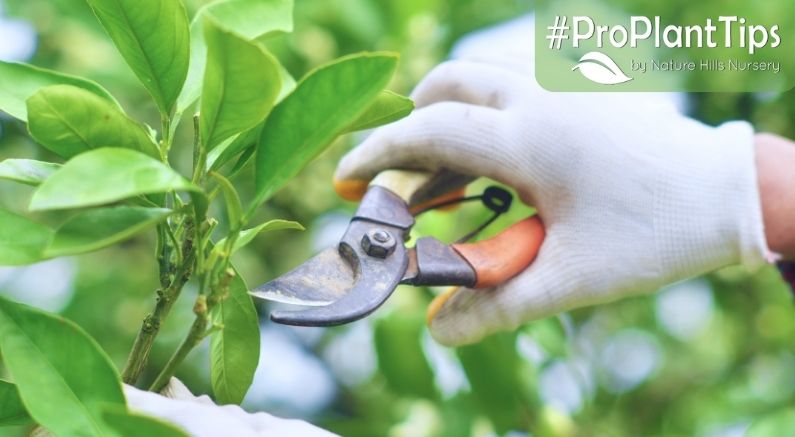
Apple tree pruning plays an important role in ensuring proper growth and fruit production, increasing fruit size, and increasing tree vigor. And, pruning encourages the tree to grow more during the growing season. Begin from the very first season after planting and continue yearly until the tree matures.
One of the primary problems faced by gardeners when growing Apple trees is that they do not understand how and when to prune their Apple trees properly.
Before growing one, any gardener must fully understand these pruning basics. Luckily, the easy-to-grow Apple tree is one of the best types of beginner fruit trees for any new gardener to start with!
Nature Hills Nursery is here to take all the guesswork out of it for you!
How Do I Prune an Apple Tree?

Fruit tree pruning should take place annually, and should be done in late winter after the coldest weather has passed. There are two stages of pruning that take place during the life of a fruit tree to keep it bearing fruit for the long haul.
All this pruning may seem harsh but it will lead to larger harvests and a stronger, more productive tree in the long run!
Apple Tree Pruning Basics
The type of tree and the look you’re going for will ultimately determine which of these pruning styles to adopt. The two main types of pruning styles are:
Central Leader Pruning:
A strong central leader is what gives most trees their height and pyramidal shape. Removing competing leaders and pruning off water growth, and crossing branches will maintain the shape of your tree.
Best done for Apple trees, Pears, Cherry trees, and some Plums, leader cutting on a young tree encourage new lateral growth and branches, preventing a young whip from becoming a tall, skinny single stem with no branching, and then re-train a single leader after the new growth at the top resumes. However, cutting the main leader on an older tree will dwarf or stunt your tree.
Open Center Pruning:

Pruning to open the center of the crown, also called vase form, allows sun and air circulation in the center of that crown, as it does help fruit production and lessen the chance of disease during the growing season.
As part of a management system for heavier fruit such as Nectarines, Peaches, Apples, and other fruit tree crops, it may allow the tree to hold the weight of the fruit. It also makes it easier to harvest, and of course, as mentioned above allows more sun and air circulation which possibly reduces the amount of disease susceptibility.
Training Young Trees
The two most common fruit tree pruning orientations are the central leader and the open center. The shape that will work the best depends on the type of fruit tree being grown. Once this framework is established, maintenance pruning is easy to perform on an annual basis.
Straight Trunks
Straight trunks are a must for the strongest trees, so when you first receive your tree and get it planted, be sure to stake it so it grows straight and perpendicular to the ground. Using a tree stake support kit will help a lot, especially if you live in an area with strong winds, storms or heavy drifting snowfall. Then, after that first season of being staked and your tree is nice and straight, remove that stake.
Competing Leaders
Maintain one single, central leader and try and maintain spreading branches that are able to hold the weight of the fruit.

Shaping
Shortening up new growth in summer can be used to keep your tree the size and shape you like best. Nip out crossing and inward growing branches, and any that are growing into the canopy, angling all branches towards the outside of the tree. This means that branches are perpendicular to the leader.
There should be an area of about two feet between each level to allow for light to reach the interior and lower leaves and fruit. The first level of branches should begin between twenty-four to thirty-six inches above the surface of the soil.
Suckers & Water Growth
Keep any suckers that develop from the rootstock keeping the energy going into the crown, and remove all water growth (straight fast-growing shoots on the branches). Remove the branches that are too low to the ground, trimming off the bottom third of any lower stems flush with the trunk, and be careful not to cut into any collars that are forming at the base of each branch.

This pushes all the root’s energy pushing into the crown and ensures it doesn’t get redirected into useless non-fruiting growth.
Pruning at Maturity & Maintenance Pruning
Once your Apple tree is producing lots of fruit, be sure you prune to maintain an open, spreading tree with outstretched arms and fingers to hold all of that nice fruit without damage to the tree. Open and spreading form coming off of the main trunk with the fruiting spurs along the stems to hold the fruit evenly spaced.
Late spring or summer pruning involves:
- Thin water sprouts that arise from the trunk keep the center open - reducing disease
- Removing small, malformed, or excess fruit (See Thinning Fruit)
- Reducing branching where too emerge from the same node - weakening the tree
- Suckers growing from the base and water growth - sap energy and strength
Late winter, before you see new spring growth, is the best time to prune for:
- Any large limbs that need to be removed
- Remove branches growing inside the framework that crowd or clutter the interior
- Remove diseased, dead or damaged branches
- Renewal pruning - removing old wood encourages new, revitalized growth
- Remove water sprouts or water growth
- Crossing branches or rubbing branches introduce injury or disease
- Angle all cuts to an outward-facing bud in the direction you want the branch to grow
Thinning Fruit
Thinning out the fruit is also important to proper Apple tree pruning. The fruit grown by the tree is oftentimes too heavy for the branches, potentially breaking branches by the sheer weight. Thin fruit in June or July, depending on your climate and tree.
Thin by removing the smallest Apples from each branch or cluster, allowing the larger fruit to develop and balance weight and even out the fruit set. This will reduce the burden on the branch, as well as increase the chances for a full crop the following year, forcing all energy and nutrients into just a few fruits per branch for larger, healthier crops, rather than lots of very tiny fruit.

The Pruning Cuts Themselves
- Always start with clean, sharp and disinfected pruning shears. This way you reduce tearing and injury to the tree (and potentially yourself) and the spreading of fungus and disease from tree to tree. Sanitize your shears between cuts to disinfect them. (See the DIY Pruner Sanitizer below)
- Prune branches at a 45° angle just above a bud that isn’t facing inward back inside the tree’s canopy.
- Be sure you are cutting back to the larger limb flush without cutting beyond the ‘collar’ of the branch. This way you aren’t damaging the tree and introducing an area where disease or insects can slip beneath the bark.
- Remove fallen branches and any pruned branches to eliminate transmission of disease or call destructive insects. The same goes for leaf litter that may harbor issues.
- When reducing the length of any branch, do not cut more than 1/3 of the length of that branch.

Pruning will give you the most beautiful, healthiest and most productive tree, not to mention peak longevity for your investment! So sharpen those pruning shears and get going!
DIY Pruner Sanitizer Spray/Dip/Wipe
When pruning out disease or healthy tree stems and branches, after each and every pruning cut, disinfect your tools by wiping, spraying down or dipping them into a mixture of 1-part Chlorine Bleach and 9-parts water. You can also use a minimum of 70% isopropyl alcohol to wipe, dip or spray on your tools to kill any possible cross-contamination between affected parts of the tree and healthy tissue.
Other Pruning Methods
High-Density Planting
High-density planting techniques allow even the smallest property or urban courtyard to accommodate these fruiting trees and their pollinator buddies. We even have a great YouTube video!
Espalier Pruning
For a unique space-saving pruning technique you can try with your young tree, try training it in Espalier form! A flat-trained ladder that won’t take up much room and adds a high-style specimen tree for your garden.
Apple Tree Pruning FAQ

How Much Can You Cut Back an Apple Tree?
Never remove more than a third of your tree or shrub at any time per year. This prevents stress on your tree and reduces the chances of overgrowth that’s overreacting to that severe pruning - in the way of water growth and suckers as the tree tries to recover from its extreme haircut.
Can You Cut the Top Off an Apple Tree?
Young trees can be topped or have the main leader nipped off to begin training them shorter from day one. This encourages side branching as well since new trees can often just have a long central leader and no branching, looking more like a fishing pole than a tree!
Older trees can also be topped in stages, just as long as you aren’t removing too much of the tree at any one time. Sometimes the more vertical branches are pruned back to the more spreading branches to better hold the weight of the fruit.
Fruit tree pruning can be dwarfing and may be used to control the size of the tree as well, a bonus when you have a smaller lot and not enough room for a standard-sized tree.

When Should Apple Trees Be Pruned Back?
Pruning Apple trees should be done in the winter or very early spring when they are dormant. Without the leaves in the way, it's much easier to see the framework of the tree and to see any damage. Prune out any diseased or crossing limbs at this time as well
NatureHills.com does offer Apples grown on semi-dwarfing and dwarfing rootstock to keep the mature size of the plants smaller naturally.
Apple Tree Care
Planting your tree in the right location is half the battle! Provide a well-drained, sunny location with good air circulation. Never plant too deep. Mulch the area over the roots with arborist wood chips and maintain 3-4" for best results. Water as needed during dry spells to keep your plant stress free.
Pollination
Apple trees can be either self-fertile or need a pollinator to produce a harvest. A few Apple trees are self-fruitful in some climates, but most will need a pollinator partner so do check out suggested partners. Many times white flowering Crabapples make good pollinator partners for Apple varieties. Nature Hills lists the appropriate pollinator partners for each tree on that plant's description page. Even if they are self-pollinating, all fruiting trees enjoy a pollinator partner to further boost the yields of both trees!
Pick your Apple Tree Variety Today!

Apple trees are an orchard standard and all-round family favorite for healthy eating! They’re versatile in the kitchen and portable food! Not just all that, but the flowers, foliage and sometimes fall color make them ideal ornamental edible landscaping trees that boost curb appeal and your family’s food sustainability!
With so many varieties available, we’re sure you’ll find the perfect Apple tree for your yard at NatureHills.com! Large and small, sweet to tart, and varieties that ripen early, midway, and late in the season to ensure you’ll enjoy these delicious fruits all growing season long!
Nature Hills makes it easy to find the right tree for you and provides you with all the aftercare you need for the life of your tree!
Happy Planting!

