Free Shipping on Orders $199+

Growing Zone: | Garden in
Find your Growing Zone!

#ProPlantTips: How to Care for & Grow Birch Trees

#ProPlantTips: How to Care for & Grow Birch Trees - Nature Hills Nursery

Charlotte Weidner |

Gorgeous trees with their Iconic peeling bark, finely-textured leaves, and unique features, the graceful Birch Tree is a landscape and woodland favorite!

Often displaying multiple trunks or multi-branching forms, these deciduous trees boost curb appeal anywhere they’re planted with unique catkins, fall color, and airy elegance! People in northern climates love the Birch tree’s exquisite branching, attractive foliage, and unique bark.

Delight in the pointed, feather-veined leaves from the earliest days of spring through summer. They'll bring refreshing light shade and white noise from their rustling leaves.


All About Birch Trees

One of the world's loveliest deciduous trees, Birch trees (Betula) are some of our all-time top-selling trees. You’ll find a delightful selection of Birch trees for sale at Nature Hills Nursery, with a variety to suit a number of tastes!

Birch tree at sunset

This celebrated tree served as ancient paper, much like an arboreal Papyrus, with manuscripts found dating back to the 1st century CE in Afghanistan. Featuring around 40 - 60 varieties around the world and belongs to the family Betulaceae.

The usual lifespan of the birch is 40-50 years. In favorable conditions, this tree can live for as long as 200 years. Birches were among the first trees to become established after the glaciers receded and can be found throughout and are still known as ‘pioneer species‘ due to their ability to grow on uncolonized land throughout North America, Europe, and Northern Asia in both tree and bush forms.

The Birch limbs and branches look great in outdoor winter décor and containers or kept as a decoration near your fireplace. These are hardwood trees and their lumber is highly valued as firewood and for furniture making.

Both male and female flowers bloom on the same tree, and the long male catkins are quite showy and are wind-pollinated and self-pollinating!

Types of Birch Trees

Birch Tree Care

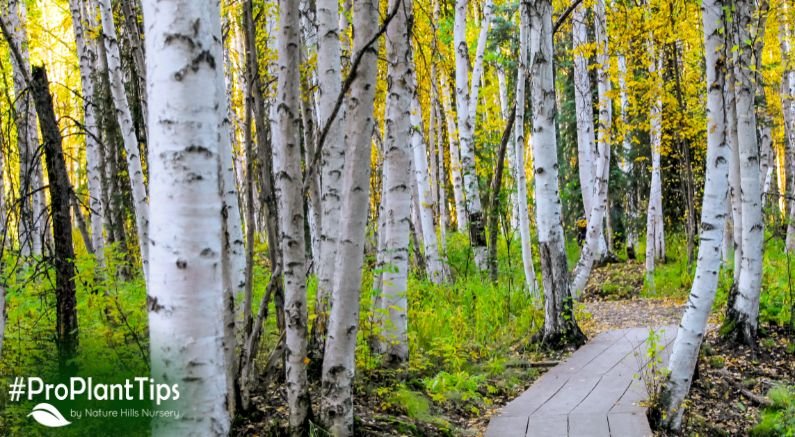
birch trees in forest

These ornamental trees need full sun but a few are understory trees and handle part shade. Birch trees do well in well-drained moist soil, and their lovely form looks beautiful and reflected in the water. Birch trees are adaptable, but grow best in acidic soils. Birch can even be salt-tolerant and handle well-draining clay soil.

Forming clusters and colonies in nature, Birch is very cold-hardy down to zone 2 and up to USDA growing zones 9. Fast-growing, these trees can mature to a wide range of heights and widths.

From the little grafted Magical® Globe Birch to the large and in charge Heritage Birch, these trees are seldom damaged by deer and are a caterpillar host plant for Tiger Swallowtails, Morning Cloaks, and Common Tortoise Shell Butterflies.

Young trees do not have the exfoliating bark or the white bark (depending on the variety) until they get at least 5-plus years of age. Only then do they begin to mature, Birch then form their characteristic bark features! Nature Hills sell Birch trees already at least 3-5 years of age and will develop their key features after just a few years in your landscape!

Keep your tree well watered throughout drought conditions and mulch the site with 3-4 inches of arborist bark chips to help hold in moisture better.

Prune Birch trees in late spring to avoid the sap (like Maple trees) from leaking during the early spring and making a mess or opening the door for pests and disease.

Top 5 Birch Trees at Nature Hills

Top 5 Birch Tree Infographic

Large or small, a Birch tree or grouping of Birch adds that special touch of elegance to your landscape! Check out these fan favorites at Nature Hills!

Whitespire Birch Tree

The Whitespire (Betula populifolia 'Whitespire') is a white-barked larger and a form of the Gray Birch. Featuring improved disease and pest resistance, these are sophisticated front and backyard landscaping trees throughout USDA growing zone 3 to 7.

River Birch

Graceful cinnamon-brown peeling bark, the River Birch (Betula nigra) is cold-hardy throughout USDA growing zones 3 to 9. This buttery yellow fall color native selection is especially resistant to Bronze Birch Borer.

Royal Frost® Birch

Dark foliage and a pyramidal elegant form, with burgundy-red to plum-purple leaves, the Royal Frost® Birch (Betula x 'Royal Frost') also brings yellow/orange/red fall color to the landscape! The young dark bark matures white with age and is cold-tolerant throughout USDA growing zones 4 to 7, Royal Frost® is a standout specimen.

First Editions® Parkland Pillar® Birch

Unique columnar Birch with white bark, the Parkland Pillar® Birch (Betula platyphylla 'Jefpark'), keeps a slim profile of only 6-7 feet wide but 30-40 feet tall. The upright form and yellow fall color handle USDA growing zones 3 to 7.

Shiloh Splash River Birch Tree

Lovely white and green variegation, the Shiloh Splash (Betula nigra 'Shiloh Splash') is a River Birch with exfoliating bark and grows to a slim mid-sized reveals cinnamon, peachy-pink, tan, and creamy white bark for winter interest. Hardy throughout USDA growing zones 4 to 9.

Elegant Birch Trees at Nature Hills!

The shaggy look of the Birch tree is sophisticated, handsome, and a bit rugged. It works beautifully with all styles of architecture, from contemporary to traditional. Carefree, hardy trees, are excellent choices for year-round interest in your yard and provide airy, breezy shade for you and your family. Consider this the perfect accent in a naturalized, rustic setting.

Check out all the Birch Trees available at Nature Hills and get your own elegant specimen delivered to your doorstep! In just a few years, you’ll enjoy all the benefits and perks that members of the Betula family have to offer in your landscape today!

Happy Planting!

Shop Birch Trees
Previous Next

Frequently Asked Questions

How big do knockout roses grow?

I notice there's a mismatch between your question about knockout roses and the provided article about birch trees. The article doesn't contain any information about knockout roses - it focuses entirely on birch tree care and characteristics. Could you either: 1. Provide an article about knockout roses, or 2. Ask a question related to the birch tree content you've shared? I'd be happy to write an FAQ answer once I have the relevant information to work with.

What are the ideal soil conditions for planting birch trees?

Birch trees thrive in well-draining, slightly acidic to neutral soil with a pH between 5.0-7.0, and prefer consistently moist conditions without waterlogging. They perform best in loamy or sandy soils that retain moisture while allowing excess water to drain freely. Plant in areas with good air circulation and avoid heavy clay soils that stay soggy, as birches are susceptible to root rot in poorly drained locations.

How much sunlight do birch trees need, and can they tolerate shade?

Birch trees perform best in full sun to partial sun conditions, requiring at least 4-6 hours of direct sunlight daily for optimal growth and bark development. While they can tolerate light shade, insufficient sunlight often leads to sparse branching, reduced fall color, and increased susceptibility to pests and diseases. In zones 2-7 where most birches thrive, morning sun with some afternoon protection actually benefits these trees in warmer climates. Plant your birch in a location with morning sun exposure and ensure good air circulation for healthiest growth.

In which USDA hardiness zones do different birch tree varieties grow best?

Most birch tree varieties thrive in USDA hardiness zones 2-7, with some species like Paper Birch performing best in the cooler zones 2-6, while River Birch tolerates warmer conditions in zones 4-9. European White Birch and Yellow Birch generally prefer zones 3-6 for optimal growth and longevity. Check your specific zone and choose heat-tolerant varieties like River Birch if you're in zones 7-8, or stick with Paper Birch and European varieties for zones 2-6.

How often should I water young birch trees, especially after planting?

Young birch trees need consistent moisture during their first 1-2 years after planting. Water deeply 2-3 times per week during the growing season, providing 1-2 inches of water each time to encourage deep root development. In zones 2-7 where birches thrive, reduce watering frequency in fall but maintain moisture through winter in warmer zones. Apply a 2-3 inch layer of mulch around the base to retain soil moisture and protect shallow roots.

Why are the leaves on my newly planted birch tree turning brown?

Newly planted birch trees commonly experience leaf browning due to transplant shock or inadequate watering, as their shallow root systems require consistent moisture to establish. This stress response typically occurs within the first 4-6 weeks after planting and can also result from hot, dry conditions or poor soil drainage. Ensure your birch receives 1-2 inches of water weekly, mulch around the base to retain moisture, and avoid fertilizing until the tree shows new growth signs.

What is the best way to prune birch trees without causing sap bleeding?

Prune birch trees during their dormant season from late fall through early winter (November through February) to minimize sap bleeding, as birches are heavy bleeders when pruned during active growing periods. Make clean cuts just outside the branch collar using sharp, sterilized pruning tools, and avoid pruning more than 25% of the canopy in a single season. Focus on removing dead, diseased, or crossing branches first, then address any structural issues. Schedule your pruning well before spring sap flow begins in March for healthiest results.

Can I plant birch trees near structures like sheds or barns without root damage?

Birch trees have shallow, spreading root systems that can extend 2-3 times the width of the canopy, so plant them at least 15-20 feet away from structures to prevent foundation or utility line damage. Their fibrous roots actively seek moisture and can infiltrate septic systems or drainage pipes if planted too close. Most birch varieties reach 40-60 feet tall with similar spread at maturity, requiring adequate space for both roots and canopy. Choose your planting location carefully, considering the tree's mature size and keeping it well away from buildings, walkways, and underground utilities.

How do I prevent bronze birch borer infestations in my birch trees?

To prevent bronze birch borer infestations, maintain optimal tree health through consistent deep watering (1-2 inches weekly) and avoid stress from drought or poor soil conditions. Plant borer-resistant varieties like River Birch or Paper Birch in zones 2-7, and apply systemic insecticides containing imidacloprid in early spring before adult emergence in May. Keep trees well-mulched and avoid soil compaction around the root zone to strengthen their natural defenses against this destructive pest.

Which birch tree variety is best for warmer climates or wet soils, like River Birch?

River Birch (Betula nigra) is indeed the top choice for warmer climates and wet soils, thriving in USDA zones 4-9 compared to other birches that prefer cooler northern conditions. This native species naturally grows along riverbanks and flood plains, making it exceptionally tolerant of poor drainage and clay soils where other birches would struggle. Unlike paper birch and other northern varieties that suffer in heat and humidity, River Birch maintains excellent health in southern landscapes. Choose River Birch for any location with challenging soil moisture or temperatures above zone 6 for reliable long-term performance.

Find Your Garden's Growing Zone!

Your Current Growing Zone:

Zone

ZIP Code:

✓ Growing Zone Set Successfully!

Your zone has been saved and will be used throughout the site.

⚠ Unable to locate a growing zone for that ZIP code.

Please check your ZIP code and try again.

Looking up your growing zone...

When ordering a tree or plant, make sure to know your planting zone.

You can determine your garden's USDA hardiness zone by entering your Zip Code below.