
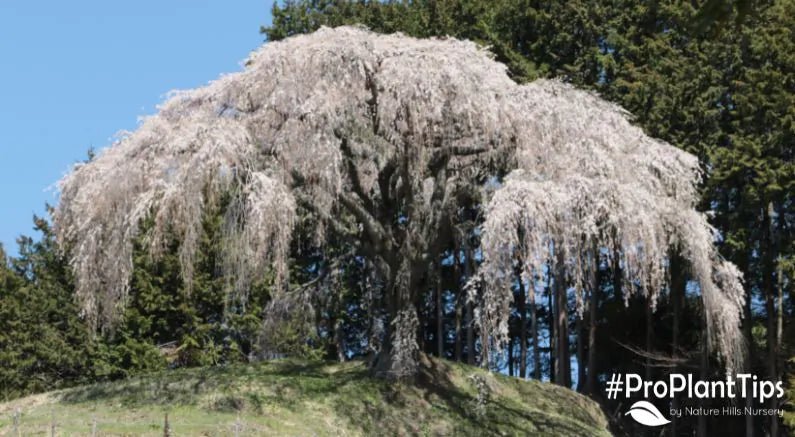
Nature Hills offers many unique and unusual ornamental trees for your landscape, but none are quite as captivating as a poetic Weeping Tree!
Gorgeous and expressive throughout all four seasons of the year, these drooping or cascading ornamentals can come in many forms and bring a fanciful feel to your landscape! A weeping ornamental becomes the finishing touch to an outdoor garden room, or becomes the crown jewel to your home’s front yard berm!
Think of these Weeping Ornamental trees as a piece of sculpture for your garden!
Weeping Tree Basics
Weeping trees are specialty trees, and like our grafted flowering ornamental shrubs and tree forms, a lot of labor and expertise goes into creating these beautiful trees at the nursery!
Because experts are growing these plants to a size that can be boxed and shipped to your door, the plants need to be grown for several years in the nursery to allow them the time to form mature root systems and for the grafts (if any) to become secure!
Most of these ornamental trees are typically five years old before they ship to you. These specialized weeping forms of plants are carefully grafted and grown for several years before we ship them. We also have to be sure to not grow them too large. This ensures our nursery can fit their unique forms into a state-of-the-art shipping box safely and ship them without any damage.
Often Weeping Trees grow up before their stems weep over, so to protect their limbs and branches, great care and timing go into shipping your new living sculpture.
Weeping Trees can be created in three different methods:
- They may start as Ornamental Vines that are trained into a tree form similar to how Wisteria Trees and Trumpet Vine Trees are created. These are trained onto a stake to encourage a straight, woody trunk
- May start as a naturally weeping shrub or weeping form tree that is grafted onto a straight standard trunk or trained on a stake to have a straight trunk of its own before being allowed to droop in an umbrella form at the top. Typically grafted 3-4 feet above the rootstock.
- A natural sport, cultivar, or hybrid that exhibits a weeping form, like Weeping Willows.
How Grafted Trees are created:
- First, we grow a rootstock. Sometimes, a separate trunk (called the standard) is also grown to make the main stem and sometimes the weeping top as well.
- In the third season, we bud or graft the standard onto that rootstock or trunk, and secure the weeping tree or shrub (the scion) onto the rootstock, but the scion may also be separate and then top-grafted.
- Then we grow these grafted trees for another 2 years or so to develop the weeping tops and ensure all graft unions are secure and healed.
These young and vigorous plants typically spend their first few years in the field (not a pampered greenhouse) so they develop out in the sun, wind, and weather to ensure they will be a success in your landscape! They are then dug up and transplanted into nursery pots to finish their growth for another year or more in the container that we then ship to you!
Important Note About Your New Weeping Tree!
The weeping tops of these grafted plants are still considered immature plants and may not be weeping just yet. It can take a few years before their true weeping form develops to its fullest - going through an 'awkward teenager stage' before transforming into their final form.
It is common for new weeping growth at this age to grow straight up before drooping over later that year or the next! It is also sometimes tricky to get young plants to have uniform branching to form the “umbrella-like” weeping top immediately, so some patience as they grow is needed.
When you receive your new tree, there may be one nice trunk with a couple of simple weeping branches coming off from the main stem. With some patience, training, and annual pruning, you’ll achieve the desired tidy umbrella shape.
Maybe you are not interested in the 'perfect' weeping form and would rather allow it to have some character and its own unique shape, this means less work and pruning and allowing the plant to grow.
There’s nothing more romantic than a weeping tree with its limbs sweeping the ground and spilling out over a raised berm!
Top Weeping Trees At Nature Hills!
Let's jump into our top favorite Weeping Trees and Tree-Form ornamentals on the NatureHills.com website!
1. Weeping Redbud Trees

Redbud Trees seem to have the corner market on dramatic foliage and weeping forms. Already gorgeous specimen plants, but when you add the flowing branches to the mix, you get something truly magical! Here are some of our favorites that will adorn your landscape!
- Whitewater Weeping Redbud
- Ruby Falls Weeping Redbud
- Lavender Twist Weeping Redbud
- Cascading Hearts Weeping Redbud
- Pink Heartbreaker Weeping Redbud Tree
- Vanilla Twist Weeping Redbud
- Golden Falls® Weeping Redbud
The gorgeous heart-shaped leaves and early spring, hot pink to white Pea-family flowers are among the first bloomers of the year!
2. Weeping Flowering Fruit Trees
While fruit trees already have gorgeous spring blooms, these fruitless weeping trees may not put food on the table, but they will serve up incredible whimsy and beauty all year round! There are even a few that still produce small fruit!
Weeping Cherry Trees are fragrant and spectacular flowering focal points! Look into the Yoshino, Pink Weeping Cherry, the White Snow Fountains® Weeping, the Weeping Extraordinaire™ Cherry, Higan's Pink Weeping, Weeping Pink Infusion™ Cherry, Pink Snow Showers™ for something out of the ordinary!
Other Weeping, flowering fruit tree varieties that don’t necessarily produce fruit include:
- April Showers™ Weeping Crabapple Tree
- Pink Cascade™ Weeping Peach Tree
- Magic Fountain™ Weeping Persimmon Tree
- Chaparral Weeping Mulberry Tree
- Purple Plunge Weeping Flowering Plum Tree
These spring flowering trees are a boon to early emerging pollinators and encourage you to burst outdoors during the first warm days after a long winter!
3. Vines Trained Into Flowering Tree-Forms

Vines trained on a stake to form a straight woody trunk, or grafted onto a straight trunk standard, are gorgeous, fast-growing flowering ornamentals!
- Summer Jazz Fire Trumpet Tree - Red-orange blooms that last all summer til frost and hummingbirds adore!
- Wisteria Vine Tree-Forms - From the famous Blue Chinese Wisteria Tree to the Amethyst Falls Wisteria Tree, Wisteria Vines quickly become beautiful Wisteria tree forms with ease!
Nearly any Flowering Vine that has woody stems with age can be trained into a tree form by trimming and encouraging a single stem onto a stake and only allowing that one stem to form, removing all branching from the trunk and roots. Snipping the top to encourage branching each year until you have an umbrella canopy.
4. Weeping Evergreen Trees
Need a weeping tree and an evergreen tree combined? Nature Hills has you covered with these fantastic conifers with year-round greenery and pendulous forms!
- Weeping White Spruce Tree
- Weeping Norway Spruce
- Green Arrow Weeping Alaskan Cedar
- Weeping Blue Atlas Cedar
- Slenderina Weeping Blue Spruce
- Bruns Weeping Serbian Spruce
Remember, these trees typically grow slowly, so it will take some patience until they reach their full potential.
5. Weeping Deciduous Trees
Deciduous trees and flowering ornamentals have their own perks and qualities, plus fall color and plenty of winter interest, as the drooping branches take winter appeal to the next level!
- Young's Weeping Birch Tree
- Camperdown Weeping Elm
- Weeping European Beech Tree
- Weeping Japanese Snowbell
- Weeping Persian Ironwood Tree
- Weeping Cut Leaf Birch Tree
- Elizabeth Lustgarten Weeping Kousa Dogwood
- Morioka Weeping Katsura Tree
- Weeping French Pussy Willow
- Weeping Willow Like the Prairie Cascade Willow
- Cascade Falls Bald Cypress Tree
These weeping trees sculpt the snow on their cascading branches and bring an architectural quality to your landscape!
6. Other Weeping Ornamentals
These weeping and ornamental shrubs have gorgeous branching that brings a magical effect to your garden!
- Purple Pixie® Weeping Fringe Flower Shrub
- Weeping Siberian Pea Shrub Tree Form
- Walker Weeping Caragana
- Red Dragon Contorted Filbert Tree Form - contorted unique branching
- Sacramento Weeping Crape Myrtle Tree Form
- Harry Lauder's Walking Stick - the unique curved and twisted branches are truly unique
Small-scale ornamentals like these work fantastically in planters and small courtyards!
Caring For Weeping Trees
These trees need just a bit of extra protection and care to keep them growing beautifully!
Sun Needs

Remember to site your Weeping Ornamental tree in a sunny place! Flowering trees need at least 6 hours of direct sunlight in order to have the most blooms, but some of these trees can handle afternoon shade or part shade in hotter climates.
Soil and Drainage
These trees need well-drained soil with consistent moisture and fertility. If there is a drainage problem, then mound native soil up 18-24 inches over the spot you will plant, then plant directly into this bermed-up area. This also creates some interest in the planting, setting your weeping ornamental higher for all to see!
Provide regular fertilizer for your trees to keep them growing healthy.
Trunk Protection
Be sure to protect the trunk from rodent or rabbit damage, or prevent deer from rubbing their antlers on the trunk - all of which can kill the plant if the bark is damaged around the circumference. A mesh metal screening or hardware cloth is great to use as it allows the trunk to remain dry after it rains.
For trees planted directly in your lawn, you also want to provide a ring of mulch around your tree to separate it from the turf. The reasons are that many of these flowering trees do not like excess nitrogen for your grass, stop pesticide and herbicide drift, and protect their trunks from weed whackers and mower damage.
Site Selection
These trees have grafts that need some extra help during winters and drought.
- Avoid planting these trees in low areas that collect cold air and where frost can settle
- Provide regular moisture throughout the growing season
- Cover the entire root system with a 3-4 inch deep layer of arborist mulch
- Never cover the graft in too much mulch or plant your tree too deeply (or too shallow)
- In marginal growing zones, you can either plant smaller trees in containers and move them into a protected location for the winter, or wrap the trunk and graft union in protective material as you would Rose Trees.
Watering Needs
All plants need regular moisture access and deep watering to encourage a deep and established root system. Once settled into their new home, many of these trees only need supplemental moisture during the summer heat, drought, and before winter so their roots don’t dry out through the winter.
Provide mulch to hold in the moisture and insulate the roots consistently. In hot growing zones, you can save trips with the hose by installing drip irrigation to ensure you get water directly at the roots.
Always use the Finger Test to ensure you are watering deeply! Average watering only wets the surface few inches. You must ensure you’ve completely saturated the entire root system of your young plant each time you water!
Surface watering does not help develop a deep root system. Longer watering less frequently, ensures you get moisture to the entire root system instead of just on top where it can evaporate. Never allow a new tree or plant of any kind to dry out too much between waterings! This will lead to root death, hamper new root formation, and cause your new tree to become stressed right from the start.
Pruning Weeping Trees

Annual Pruning may be needed to shorten up or train the branches for uniformity, or to prevent fast-growing species from outgrowing their space. It may take some work, and a couple of more seasons of growth to get your Weeping Ornamental tree to be the way you like it.
Typically, it is recommended you prune after the bloom finishes, or when some deciduous trees are dormant. Nature Hills Nursery lists pruning time on each plant's page and Plant Highlights section for you.
Customers also like to trim the longest branches to keep them shorter so the entire plant's uniformity can catch up to finish the umbrella-like look!
If you find that your Weeping Tree is not making enough branches where you want them, you can trim off the branches that exist back to the main trunk, leaving a stem with a few healthy buds. These buds will branch and produce more branching to fill out the top central
crown when it is young.
You may also want your Weeping Ornamental plant to grow taller than wide. This is simply done by staking and training some of the topmost branches to continue to grow straight up. Holding them in this position until they mature and develop a woody trunk that won’t need staking. Then you can allow them to grow into a cascading shape, creating a taller crown and canopy.
All of this is easily done when the plants are young, vigorous, and easier to train.
Many gardeners like to take advantage of these young trees to train them with more character and treat them like Bonsai plants.
It is also important to remove suckers coming from your rootstock and nip off any side branches developing on your trunk.
Once older, you can begin 'limbing up' your tree so you can walk beneath it or set a comfy chair beneath the canopy.
Something Magical Right This Way!
Adorning your front yard berm, accenting your home’s foundation plantings, or as the crown jewel to your landscaping beds, Weeping Ornamental Trees bring that special je ne sais quoi to your landscape!
Everyone needs a conversation piece and something that will make your neighbors green with envy! Gain a fairytale presence in your landscape and take your garden design to the next level with Weeping Ornamental trees, tree forms, grafted flowing Vine trees, and trained shrubs!
NatureHills.com is here to help you boost your curb appeal and transform your garden into something truly magical!
Happy Planting!

