
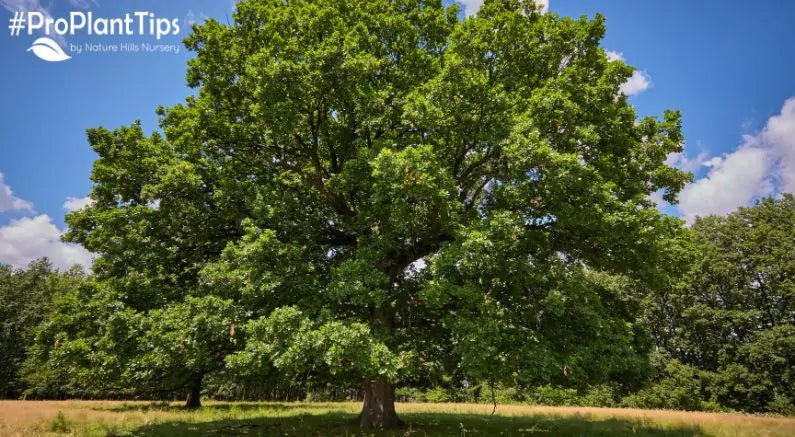
"Today's mighty Oak is just yesterday's nut that held its ground." - Thomas Carlyle
Unique-shaped leaves, strong wood, and wildlife-friendly acorns, the mighty Oak Tree is a pinnacle of the forest and urban landscape! These hardwood deciduous and broadleaf evergreen trees, widely distributed throughout the Northern Hemisphere, include about 500 species, 90 of which are in the US!
Members of the Beech (Fagaceae) Family, Quercus are made of several sub-varieties, all of which are gorgeous in their own unique way!
From the Swamp Oak to Sawtooth, Chestnut Oak, Chinquapin, and Black Oaks, the range of these trees is vast! Let’s take a look at all the fantastic qualities that set these mighty trees apart from the rest!
Acorns and Leaves Contain Tannic Acid That Repels Insects
Spring brings long male catkins and female flowering spikes on the same tree. The leaves emerge and are glossy and green and lobed, with acorns that develop in the fall, often with a range of fall colors! The leaves of many Oaks remain on the tree through the winter and combined with the persistent acorns, bring plenty of interest through the snowy months.
Long-lived, with deep roots, and an incredible adaptability to a wide range of climates and growing zones, there is an Oak tree perfect for your landscape needs and size! Read up on your particular variety of Oak, as some can have more shallow roots that prefer to spread rather than go deep.
Squirrels, ground fouls, wild hogs, small rodents, raccoons, rabbits, opossums, ducks, and many birds rely on acorns for sustenance.
Not only are Oaks incredible wildlife and bird-friendly fortresses, shelter and nesting sites, and food sources, but Oaks also support more than 950 species of Lepidoptera caterpillars! The flowers are not highly sought after by pollinators because they are wind-pollinated, but they are Host Plants for their larvae. This doesn’t mean Oaks are buggy trees, in fact, these larvae sustain the chicks of hundreds of species of Songbirds!
Living generally 150-250 years, the oldest trees can be over a thousand years of age. However, an Oak isn’t considered mature until it is around 75 years old.
Acorn Caps Are Called Cupules
The Two Major Groups of Oak Trees
White Oak Group
The White Oak family includes the White Oak itself plus:

- English Oak
- The shaggy acorn-capped Bur Oak
- Overcup Oak Trees have acorns completely enclosed by their caps
- The wavy-leafed Chinkapin
- The wetland-tolerant Swamp White
- Straight-as-an-arrow Post Oaks
- Chestnut Oaks and Swamp Chestnut With Chestnut Tree-like arranged leaves
White Oaks have characteristic rounded lobed leaves and produce acorns that mature in a single season. The Chinkapin (sometimes spelled Chinquapin) has wavy, scalloped margins on its long slender leaves.
Slow growing (about 1 foot a year) these trees can live up to 500 years in optimal conditions, creating some tough, durable, and dense wood that is used as slow-burning firewood, flooring, furniture, and more.
Oaks have been growing in North America since the glaciers receded 10,000 years ago
Red Oak Group
Named for their darker coloration, the Red Oak tree family includes:

- Red Oaks (Northern and Southern Red)
- Scarlet Oaks
- Blackjack Oaks
- Black Oak
- Shingle Oaks
- Shumard Oaks
- Nuttall Oaks
- Broadleaf evergreen Live Oaks and Southern Live Oaks (smooth margins)
- Sawtooth Oaks with margins full of tiny pointed teeth
- Pin Oak Tree (Northern and Southern Pin)
- Cherrybark Oaks with bark that resembles Cherry trees
- Moisture-loving Water Oaks
- Willow Oaks with long slender to paddle-shaped leaves
With acorns that take two growing seasons to mature, Red Oaks have pointed or bristled lobes and grow faster than other Oaks. Living up to 500 years of age, and smaller than White Oaks, they typically have brown to gray bark and can have fissures or ridges but the bark is smoother than White Oaks. Loved for its strong lumber, it’s widely used for making housing and furniture.
The oldest Oak in Europe is a Granit Oak in Bulgaria is 1637 years old
The Stelmuze Oak in Lithuania is possibly as old as 2,000 years of age
The Pechanga Great Live Oak in Temecula, California is at least 2,000 years old
Choosing The Right Oak For You
Type in your Zip Code in the Plant Highlights section to find your growing zone and find which Oak will be right for your region!

There is a wide variety of large-scale specimens available for large properties!
- If you have the room, then the wide-spreading Southern Live Oak is a hot climate specimen throughout USDA Growing Zones 8-10 with glossy evergreen leaves, growing 50 - 80 feet tall and 70 - 90 feet wide.
- For northern growers, the Bur Oak Tree is a fantastic alternative for Growing Zones 3-8, growing 70 - 100 feet tall and wide!
If you have a smaller property, then these smaller and columnar varieties will give you all the grandeur of their larger cousins without taking up as much space.
- Great street trees and space-saving wonders, try the Dwarf Chestnut Oak or Skinny Genes® Oak Trees that stay under 10 feet wide!
If you have wet soil or are planting near a water source, then you need Oak Trees like:
- The cold-hardy Swamp White
- The mid-zone Swamp Chestnut Oak
- The hot climate-loving Water Oak
- Pin Oaks can handle some higher moisture soils too!
For alkaline soil conditions:
- The Bur Oak and the Chinkapin, handle soil pH 7 and up
But if you have acidic soils:
- Choose the Willow Oak and the Pin Oak
If you have drought and xeric sites:
- Again the Bur Oak reigns
- The Shumard Oak
- Most established varieties of Oak are drought-tolerant
For the best fall color display:

- The multi-colored autumn colors of the Shumard Oak
- The fiery red Northern Red Oak
- The Swamp White Oak displays vibrant shades of yellow to reddish-purple
While most Oaks have coarse texture from their large foliage, the finer textured Pin Oaks with their shapely pointed lobes, lacy Willow Oaks, and the lance-shaped Live Oak bring an airy presence to go along with their superb size.
The best Oak trees for urban conditions that tolerate pollution include:
- The Chinkapin, Shumard
- The Post Oak.
With a wide range of hardiness to cold and heat, the Live Oak, Blackjack, Cherrybark, and Water Oak handle up to hot Growing Zones 9 to 10, while the Bur Oak, Black Oak, and Northern Red and more handle down to USDA Zones 3 and 4 winters! Plus there are many that work in the in-between Zones of 5 to 8!
Caring For Oak Trees
Symbols of Wisdom, Courage & Endurance - The Oak Tree is the National Tree of America!
The incredible Oak is also very easy to grow! Just get your new tree off on the right foot for generations of enjoyment, shade, and landscape beauty to follow! Although considered slower growing, once your new Oak is established in its new home, they are faster growing than you might guess - especially as a young plant!
Oak Tree Sun Needs
Oak trees generally need full sun, but a few varieties can handle a bit of shade when young, relying on their long lifespan to eventually outgrow their neighbors and enjoy the full sun soon enough. But you will get the best and strongest growth in 6 hours of sun a day.
Oak Tree Soil and Moisture Needs
Oaks need well-drained soil but many can become incredibly drought tolerant once established. There are many Oaks that are wetland plants and handle some clay as long as conditions aren’t stagnant.

Give your tree a planting site that is of about any kind of soil that won’t let the roots sit in water. Dig a hole as deep as your root system and a bit wider. Use the life-long symbiotic support of Nature Hills Root Booster and saturate the roots well before backfilling topsoil.
Keep new plants well-watered, not letting their root systems dry out their first year. Use the Finger Test to make sure you are keeping the entire root system watered fully. A top-dressing of 3-4 inches of arborist mulch/bark chips over the entire root system helps retain moisture, enriches the soil, and insulates the roots.
Protecting New Oak Trees
Young Oaks appreciate being staked their first growing season in the ground, but if you have heavy drifting snow and strong storms, you may want to keep them staked for their first year.
Provide trunk protection for young trees if you have high deer pressure, both to keep plants from being nibbled and from stags rubbing their antlers on the tree, causing damage.
The layer of mulch spread out to the 'drip line' of the tree protects against mower and weed wacker damage.
Pruning Oak Trees
Very little additional maintenance is needed beyond a yearly pruning when Oak trees are young and when they are dormant. Generally, pruning is done when the plants are dormant, but it is always a good idea to check with your local County Extension Office to see when pruning is suggested in your immediate area to prevent any disease spread that might be active in your area.
Remove crossing branches, limbs with weak crotches, broken branches, and (for most Oaks) any second leaders that may develop. This provides the framework for the tree for life. Some like to keep the trunk free of low branching, some don’t but do keep suckers from growing at the base or from the rootstock, to push all growth into the canopy of the tree.
Oaks have mast years with especially large Acorn crops every few years
Discover Oak Trees Today!
Long-lived Oak trees stand strong against nature’s elements, attract wildlife, and shine all spring, summer, and autumn! Oak trees are an ideal choice for adding valuable shade and color to your yard!
You’ll find a fantastic selection of Oak Trees for sale at Nature Hills Nursery!
Happy Planting!

