
“With silver bells and cockle shells, and pretty maids all in a row.” - Mother Goose
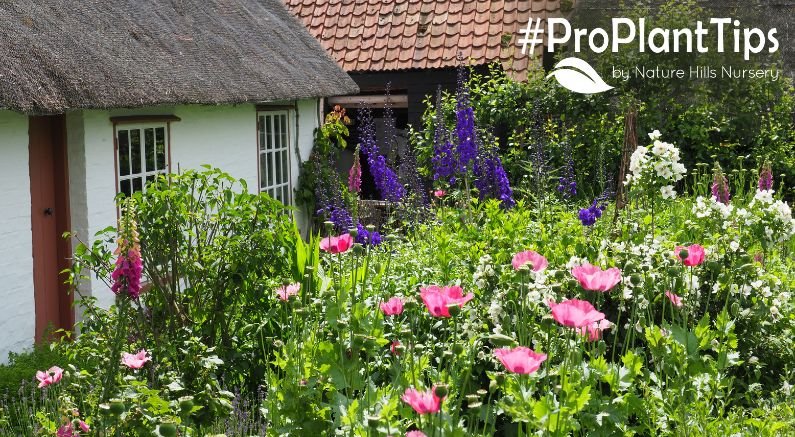
The classic Cottage Garden - Jam packed full of textures, colors, and flowers that bloom in succession. There may not seem to be rhyme or reason, but there is a common theme - to pack as many shrubs, bulbs, herbs, vegetables, and perennial flowers into an area (comfortably) as possible!
Whether you have a small urban courtyard, a corner of your backyard, a long skinny sideyard flower border, or are creating a Cottagecore garden to replace your lawn - Cottage gardens have a little (or a lot) for everyone!

Cottage Borders and Cottage Gardens conjure romantic images of nursery rhymes, childhood storybooks and fairytales, breezy summer days, and orderly chaos.
Often with a path winding down the center, an arbor heavily draped in Climbing Roses marking the entrance and flanked by a wide, densely packed mixture of groupings, blocks, and drifts of flowers.
You can almost envision a clothesline of freshly laundered linens billowing in the breeze, an orchard in the background, an old-fashioned apiary or honeybee skep in the corner. Planted in a tidy patch of organized chaos before a thatched roof cottage, with a Wisteria vine climbing up one side, kept in control by fading white picket fences, as chickens and geese roaming among the leaves, and the hum of delighted insects buzzing from bloom to bloom!
The traditional Cottage Garden is small in size but full of incredible variety!
The Cozy Cottage Garden
The late 15th century began seeing Medieval families growing their own food, herbs, and medicinal plants outside their own small homes instead of depending on farming on the land of others. Packing as much as they could into a small area.
As food and land became more readily available, flowers and trees were added too!
Often naturalized garden flowers, or tamed wilderness areas where farm animals roamed and foraged, a place where the busy gardener dropped plants that didn’t belong in either the field or the vegetable garden, but were too pretty or useful to discard.

The Cottage Garden was an informal, out-of-the-way area in the days of old. More traditional English Cottage Gardens, which were modeled after formal Italian gardens, were typically more formal and structured. But today, this unique type of landscape plot can be anything you want!
Full of whimsy, curiosities, long-lasting/long-blooming flowers, fragrant varieties, interspersed among spring ephemerals, summer bloomers, and fall stunners - a proper Cottage garden is packed to the brim with something new every change of the season!
Since Cottages are typically small, informal abodes, a Cottage garden looks best planted around a shed, mother-in-law addition, a she-shed, or a free-standing garage, but they aren’t necessarily!
Depending on the HOA and the style of your home, simply transforming your formal foundation planting of tidy sheared hedging with a biodiversity garden is certainly one method of incorporating this style garden into your landscape! Otherwise, a sunny corner of the backyard by the vegetable garden, or a narrow side yard path lined with flowers can become your respite from the modern world!
- Densely Planted
- Wide Variety of Color, Form, Texture & Bloom Time
- Architectural Focal Points, Airy Filler, Flowing/Arching Elements & Mounded Forms
- Tall Plants, Mid-Sized & Low-Growing
- Punctuation of Vertical Groupings, Trellis/Obelisk & Sculpture
- Sheared & Free-Form Flowering Shrubs
- Evergreens & Topiary
Traditional Cottage Garden Plants
The fundamentals of a proper English Cottage Garden are partly cut flower garden, part randomization, and part utilitarian - but all beautiful!
|
Tall & Architectural |
Mounded Rounded |
Mid-Sized |
Low-Growing |
|
Anemone Canterbury Bells Delphinium Foxglove Hyssop Larkspur Penstemon Tall Garden Phlox Veronica |
Butterfly Weed Catmint Coneflower Coreopsis Milkweed Poppy Mallow Salvia Sedum Yarrow |
Bell Flower Balloon Flower Black Eyed Susans Blanket Flowers Columbines Shasta Daisies Guem Oriental Poppy Penstemon Rudbeckia |
Ajuga Creeping Phlox Creeping Sedum Creeping Thyme Dianthus Lamb’s Ears Lamium Perennial Geranium Primrose Sea Thrift |

Mix in some dark foliage plants to add contrast, some airy cloud-like blooms for filler, flowing and mounding plants, and bright pops of dramatic contrasting color to catch the eye! Create gourd tunnels or install a pergola or gazebo, coax moss to grow everywhere, cover walls with Ivies, start collecting antique watering cans, and make homemade garden art!
|
Grassy Textures |
Greenery |
Airy Fillers |
Specimens |
|
Blue Eyed Grass Daylilies Iris Liriope Lucerne Grass Ornamental Grasses Spiderwort |
Artemisia Coral Bells Euphorbia False Indigo Fernleaf Peony Herbs Hosta Ornamental Grasses |
Aster Astilbe Baby’s Breath Bleeding Hearts Gaura Goldenrod Russian Sage Sea Lavender Wandflower |
Bee Balm Cardinal Flowers Hardy Hibiscus Hollyhocks Peony Red Hot Poker Sea Holly |

Mix and match your favorite flowers in densely-packed clusters, among tufts of ornamental grasses, rambling Roses, and climbing flowering vines on tuteur trellis, and obelisks made from branches to add height, as beneficial insects and butterflies dance merrily among them all!
|
Climbing Vines |
Annual Additions |
Shade Plants |
|
Clematis Climbing Hydrangea Climbing Roses Grapevines Honeysuckles Jasmine Morning Glories Passionflower Vines Trumpet Vine Wisteria Vines or Tree |
Annual Poppy Celosia Cleome Spider Flower Cosmos Flowering Tobacco Johnny Jump-Ups & Viola Lobelia Love Lies Bleeding Marigolds Queen Anne’s Lace Snapdragons Sunflowers |
Astilbe Barrenwort Bleeding Hearts Brunnera Coral Bells Ferns Hosta Lady’s Mantle Lenten Rose Lungwort |

Mimic the native flora in your area for the most natural effect!
Mix in a few annuals and a specimen tree or topiary-trimmed evergreen shrubs or Boxwood here and there, toss in some herbs and veggies, and you have the perfect Cottage Garden!
|
Bulb Plants |
Cottage Garden Shrubs |
Herbs |
|
Allium/Perennial Onion Asiatic Lilies Calla Lily Crocosmia Dahlia Fritillaria Gladiolus Iris/Bearded Iris Liatris Oriental Lily Ornamental Garlic Ranunculus Spring Flowering Bulbs Tiger Lilies |
Azalea & Rhododendrons Bluebeard Butterfly Bushes Flowering Quince Forsythia Hydrangea Shrubs Lilacs Roses Roses Roses! Rose of Sharon Spirea St. John’s Wort Sweetspire Weigela |
Catnips Dill Fennel Feverfew Flowering Chives Germander Lavender Mints Oregano Rosemary Sage Tansy Thyme |
Mix-Ins

Fill in gaps with urns and tall pots brimming with focal point plants and annuals, rocks and ‘fallen’ logs for natural elements, and add raised garden beds or berms for a tiered and layered effect. A wattle fence or recycled/upcycled low fence as edging to help contain spilling flowers will help keep your paths clear and your plants better contained.
Don’t forget to include hummingbird and bird feeders/bird baths, sculptures and garden art, an old lamp post, an antique water pump, sections of fencing or recycled garden gates to support heavy plants, and tucking a water feature into the mix!
Cottage Garden Paths
The main feature of a Cottage Garden is the path that runs through it. Either winding or straight, you can have a path of nearly anything that leads you along!
- Short mown lawn - try Buffalo Grass for a low-growing no-maintenance option
- Pavers or wood planks/wood discs with creeping groundcover between them
- Mulched paths
- Cobble, river rock, or pebbles
- Brick or slate pathways
- Low-growing Creeping Sedum, Creeping Thyme, Lobelia and Carpet Dianthus
Caring For High-Density Cottage Garden Plantings
First and foremost - find your growing zone and begin there when choosing plants for your Cottage garden.

Sun Needs
Depending on the mix of plants and if you have established trees and shrubs, you will need to start your plan to accommodate your plant's sun needs and the amount of sun available throughout the day.
Plot the sun and map out where shade from future shrubs (and the future height of these shrubs), the house or outbuilding, hedges, trees, and mature perennials/grasses will fall. Plant partial shade/part sun plants in the areas where shade from larger plants falls for more than 4-5 hours. Full-shade plants can be situated beneath the larger shrubs and in areas where the sun can’t quite fully reach.
Spacing and Competition
Because of the high-density planting technique that Cottage Gardening employs, you’ll want to ensure your plants have enough room to grow comfortably without overcrowding or competing with each other. You create more problems than needed by reducing air circulation among your plants.
Once planted, watch how they grow in order to be ready to divide clumps as needed, usually every 3-5 years, to maintain their comfort and vigor. Find your plant's mature width in the Plant Highlights section on each plant information page.
Soil and Fertility
It’s important to know each plant's fertility needs Fertilize in the spring, spread compost, and keep weed competition at bay.
Enrich the soil with ample organic matter, and spread arborist mulch between young/new plants to keep back weeds until your plants mature and establish. Mound up plants that need better drainage, and augment your soil as needed.
Watering
Water at the roots to further avoid excess moisture on the leaves by using drip irrigation, underground soaker hoses, or water in the morning so the sun dries the foliage throughout the day. But water regularly according to each plant's needs and give more water-hungry plants supplemental moisture when needed. Plants that love drier conditions can be grouped together, or planted on berms to increase their access to drainage.
The close proximity of your Cottage Garden plants will naturally reduce the evaporation of moisture in the soil, and a 3-4 inch layer of mulch helps significantly too! Plant rambling groundcovers that are shade tolerant, allow them to fill in the gaps, combat weeds, and act as living mulch while other plants are still working to establish.
Get Cozy with Cottagecore!
Don your apron, sun hat, and wellies!
Add some finishing touches to your Cottage Garden by incorporating a few large rocks, birdhouses and bird feeders, upcycled pottery (of the planter kind and the kitchen kind), bird baths, a ‘broken’ rustic fence feature, and funky garden art!
You will have an ever-changing view throughout the year, armloads of cut flowers for your vases and bouquets indoors, a variety that will have the neighbor's heads spinning, and a place where wildlife will feel at home.
Adding a hammock or Adirondack chair, bistro table and chairs, plus some antiques and herbs are the perfect additions that add a special touch to your new storybook garden! You’ll have created a destination spot to relax your mind and renew your spirit in!
Replace the lawn and begin collecting your favorite plants with the help of Nature Hills today! You’ll create a comfortable setting, stuffed with charm and color! A garden full of life, beneficial insects, and birds that the sterile monoculture of a lawn can never compete with!
Happy Planting!

