
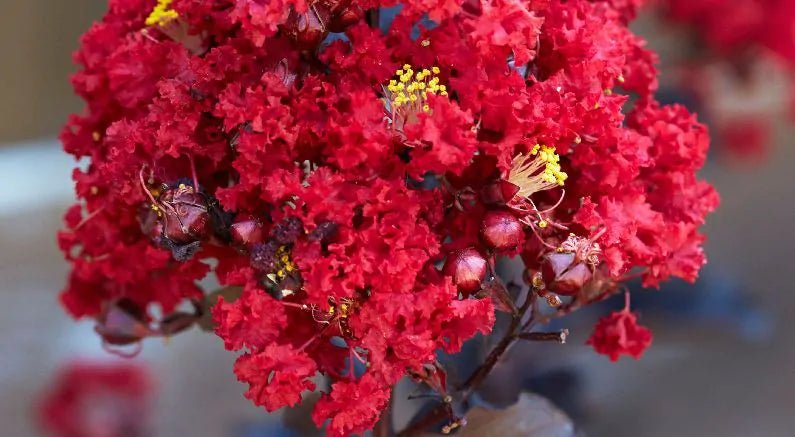
The Crape Myrtle has been renowned for its wonderful long-lasting bloom, its wide range of adaptation, and its versatility as both a tree and a shrub. With the introduction of exciting new varieties, the love affair with the Crape Myrtle is sure to continue.
All Crape Myrtles sold in the United States are deciduous. They are mostly admired for their long bloom period from late spring to fall. Most also feature an outstanding fall color display of oranges, reds and yellows. This fall color varies in degrees by variety.
They are tolerant of a wide range of soils but do require good drainage. Once established, they are quite drought tolerant, good news for water-wise landscapes.
Select the right size for your landscape first, then focus on finding your favorite color. Here is a selection guide by variety.
Learn More About This Beautiful Flowering Tree
Introduced more than 200 years ago from Southeast Asia, no less than the likes of George Washington at his Mount Vernon home have enjoyed the beauty of the Crape Myrtle. The Lagerstroemia indica which was the original species brought from China, and was the predominant selection in the United States up until the late 1950’s.
At that point, Dr. Donald Egolf, a director of the National Arboretum in Washington D.C. received seeds of a selection of Lagerstroemia, which is native to Japan. Lagerstroemia fauriei was used for its disease resistance in crosses done with Lagerstroemia indica.
What resulted were the most common varieties sold today. These are often referred to as the “Tribe Varieties” because most are named after native Indian tribes.
These plants are prized for their resistance to powdery mildew, which is a common concern with older Crape Myrtles varieties. These include:
Lagerstroemia indica x fauriei ‘Acoma’ - White flowers. Shrub or small multi trunk tree 6- 10 feet with spreading canopy. Great Mildew resistance. Wonderful exfoliating bark. Dark red fall color. This is a very hardy selection and can be grown successfully into zone 6 - 10.
Lagerstroemia indica x fauriei ‘Natchez’ - White flowers, and very cold tolerant. Much taller than Acoma with top height of 20 feet plus. Wide spreading canopy to 20 feet. Great exfoliating bark, red-orange fall color. Great mildew resistance. Zones 6-10
Lagerstroemia indica x fauriei ‘Zuni’ - Violet Purple flowers. Shrub or small single or multi trunk tree, 10 -12 feet with rounded canopy. Good exfoliating bark, red-orange fall color. Very hardy into zones 6-9
These, along with about 22 other Fauriei hybrids were introduced by the U.S National Arboretum.
Another active breeder that has had dramatic impact on the Crape Myrtle market is Dr Carl Whitcomb and independent horticultural researcher out of Stillwater, Oklahoma. His company, Lacebark Inc., is credited with many introductions of Crape Myrtle in the last 20 years.
Using almost exclusively Lagerstroemia indica seedlings and selecting the ones that had the greatest resistance to Powdery Mildew, Whitcomb would release more than 10 notable selections, several of which have become the most requested varieties. These include:
Lagerstroemia indica “Whit” ‘Dynamite’ - Dark Red blooms. Full-size tree to 20 feet tall plus. Possibly the most popular of all varieties, and one of the first true red selections. Wide range of adaptability growing well into zone 6 -10
Lagerstroemia indica “Whit III” ‘Pink Velour’ - Bright Fushia Pink blooms. Shrub or small multi-trunk tree to 10 feet with an upright canopy. Dark Orange fall color, Hardy into zones 6 – 10.
Several other selections are fast becoming popular and in time should be available as well.
New Varieties on the Market
Most recently the Black Diamond® series of Crape Myrtles and the First Editions®, Magic™ Collection have been introduced. Both with top heights more suited to modern landscapes, dynamic flower colors, unique foliage and disease resistance.
The Black Diamond are all select seedlings of Lagerstroemia indica, all selected for mildew resistance and dark colored foliage. The First Edition Magic Collection is also a mix of dynamic Crape Myrtle varieties suited for today modern landscape. More compact habit, heavier bloom set, and disease resistance really mark these next generation Crape Myrtle.
The Black Diamond® Series
Lagerstroemia x “Black Diamond” ‘Best Red’ - Striking Red blooms and deep red-black foliage with striking Red Flowers. Shrub or small multi-trunk with round canopy, to 10-12 feet tall. Red fall color, Great disease resistance, drought tolerant once established, Zone 6-9
Lagerstroemia x “Black Diamond” ‘Crimson Red’ - Crimson Red blooms and deep black foliage. Shrub or small multi-trunk tree to 10-12 feet tall with a vase shaped canopy. Great disease resistance fall colors varies with climate, drought tolerant when established. Zones 6- 9b
Lagerstroemia x “Black Diamond” ’Purely Purple’ - Vibrant Purple blooms combine with deep black foliage. Shrub or small multi-trunk tree to 10 feet tall. Great disease resistance, drought tolerant once established. Zone 6-9b
Lagerstroemia x “Black Diamond” ‘Red Hot’ - Red blooms pop against beautiful black foliage. Shrub or small multi-trunk tree to 10-12 feet tall, with spreading canopy, Good fall color, Great disease resistance, drought tolerant once established. Zone 6-9b
Lagerstroemia x “Black Diamond” ‘Blush’ - Soft Pink blooms massed against a striking black foliage. Shrub or small multi-trunk tree to 10 feet with upright form. Great disease resistance, yellow-orange fall color, drought tolerant once established. Zone 6-9b
Lagerstroemia x “Black Diamond” ‘Mystic Magenta’ - Magenta-Pink blooms contrast against a deep black foliage. Shrub or small multi-trunk tree to 10 feet tall. Great disease resistance. Drought tolerant once established. Zone 6-9b
Lagerstroemia x “Black Diamond” ‘Pure White’ - Bright white blooms contrast against a deep black foliage. Shrub or small multi-trunk tree to 10-12 feet tall. Great disease resistance, Drought tolerant once established. Zone 6-9b
Lagerstroemia x “Black Diamond” ‘Shell Pink’ - Coral Pink blooms are highlighted by deep black foliage. Shrub or small multi-trunk tree to 10 feet tall. Great disease resistance, Drought tolerant once established. Zone 6-9b
The First Editions® Magic™ Collection
Lagerstroemia x ‘Midnight Magic’ - Deep Pink blooms and dark purple foliage. Compacted round shrub from 4- 6 feet tall. Great in containers. Leaf spot and Mildew resistant, very heat tolerant. Zones 7-9
Lagerstroemia x ‘Twilight Magic’ - Coral Pink blooms showcased against dark plum colored foliage. Large tree or multi-trunk specimen to 16 feet tall with spreading canopy. Foliage remains dark when not in bloom. Great disease resistance and drought tolerance. Zone 7-9
Lagerstroemia x ‘Plum Magic’ - Fuchia Pink Blooms highlighted by plum-purple foliage. Formal rounded form, train as a shrub of small multi-trunk tree. Deadhead in late summer for dramatic rebloom. Great disease resistance and drought tolerance, zone 7-9
Lagerstroemia x ‘Purple Magic’ - Rich Purple blooms can be deadheaded in late summer for last splash of year end color. New growth has reddish tint that matures into a dark green. Shrub or small multi-trunk tree 6-10 feet tall with a vase shaped canopy. Great disease resistance. Drought tolerant once established. Zones 7-9
Lagerstroemia x ‘Coral Magic’ - Salmon Pink blooms highlighted by reddish tinted new growth. Shrub or multi-trunk tree from 6-10 feet tall with a rounded canopy. Great disease resistance and drought tolerance once established zone 7-9

